

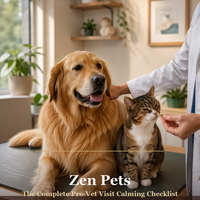
Zen Pets: The Complete Fear Free Vet Visit Guide — A Science-Backed AAFP/AAHA Protocol for Carrier Training, Pre-Visit Medication, Waiting Room Strategy, and Low-Stress Cooperative Care for Dogs and Cats
Vet visits do not have to be traumatic. Let us show you how.
The scene is seared into the memory of every pet guardian who has ever experienced it. The carrier emerges from the closet, and your cat vanishes. You coax them out, wrestle them inside, and endure the heart-wrenching yowls of protest during the entire car ride. Or your dog, who usually bounds toward the car with uncontainable joy, plants their feet on the driveway the moment they realize this is not a trip to the park. In the waiting room, they tremble, pace, pant, or cower behind your legs. When the veterinarian reaches toward them, they growl, snap, or freeze in terror. You leave the clinic feeling guilty, exhausted, and dreading the next visit as much as your pet does.
This experience is common, but it is not normal, and it is not inevitable. A generation ago, the standard of care was restraint: hold the animal down, get the job done quickly, and accept that some level of fear and struggle was unavoidable. Today, the standard is different. The Fear Free movement — founded by Dr. Marty Becker and now embraced by tens of thousands of certified veterinary professionals worldwide — has revolutionized our understanding of what a veterinary visit can be. Fear, anxiety, and stress are not merely unpleasant emotional experiences. They are physiological states with measurable, negative consequences for your pet's health and for the accuracy of the medical care they receive. An elevated heart rate can mask cardiac disease. Stress-induced hyperglycemia can trigger a false diabetes diagnosis. Cortisol suppresses the immune system and skews blood work. A terrified animal's tense muscles make accurate palpation impossible. And the neural pathways of fear strengthen with each traumatic visit, making every subsequent appointment harder than the last.
Zen Pets is a comprehensive, practical, step-by-step manual grounded in the guidelines of the American Association of Feline Practitioners (AAFP), the American Animal Hospital Association (AAHA), and the Fear Free Pets initiative. It transforms the veterinary experience by organizing the entire process around a timeline — from one week before the appointment through the post-visit recovery period — giving you specific, actionable strategies at every stage.
Inside, you'll learn how to:
- Understand exactly why your pet fears the clinic — through their eyes, ears, and nose: the olfactory assault of hundreds of animals' fear pheromones and anal gland secretions, the auditory chaos of barking and clattering metal, the tactile vulnerability of a cold stainless steel table, and the fundamental loss of control that amplifies every other stressor
- Recognize the medical consequences of clinic fear: how elevated heart rate, spiked blood glucose, suppressed immune function, and muscle tension directly compromise diagnostic accuracy and can lead to misdiagnosis or unnecessary treatment
- Implement the Fear Free philosophy as an active, essential member of your pet's care team — not a passive observer, but a prepared advocate with the knowledge and language to request accommodations
One Week Before — The Preparation Timeline:
- Complete the Week-Before Checklist: confirm the appointment, request pre-visit medication if needed, ask about Fear Free accommodations (separate cat waiting area, direct rooming, floor exams), and begin the desensitization protocols that require time to take effect
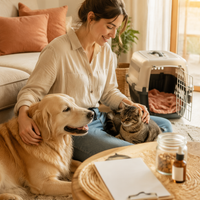
- Transform the carrier from a dungeon into a bedroom using the 7-Day Cat Carrier Training Protocol: make the carrier a permanent piece of furniture, remove the door, feed every meal inside, and build a conditioned association so powerful that the carrier predicts safety, not terror
- Desensitize your dog or cat to the car ride: break the journey into micro-steps — parked car with treats, engine running with treats, driveway and back, around the block — repeating each step until your pet is genuinely relaxed before progressing
- Train the muzzle as a treat basket, not a cage: the 7-Day Dog Muzzle Training Protocol that pairs the muzzle exclusively with peanut butter and high-value rewards, transforming it into a predictor of wonderful things
- Practice handling desensitization on every body part: paws, between toes, each nail, outer and inner ears, lips and teeth, belly, tail — one second of touch, one high-value treat, building the foundation of cooperative care
- Schedule happy visits — the single most underused tool in veterinary medicine: visits to the clinic involving no procedures whatsoever, only treats and affection, rewiring your pet's amygdala from fear to positive anticipation
- Discuss pre-visit pharmaceuticals and nutraceuticals with your veterinarian: gabapentin (safe for both dogs and cats, anxiolytic and mild sedative), trazodone (for dogs), dexmedetomidine gel (Sileo), alpha-casozepine (Zylkene), and L-theanine (Anxitane) — including when and how to administer a test dose at home on a non-appointment day
The Day Of — Hour by Hour:
- Execute the Night-Before and Morning-Of Checklist: confirm logistics, gather all supplies (carrier, leash, muzzle, high-value treats, Feliway-sprayed blanket, records, questions list), administer medication at the prescribed time, and know exactly what medicated calm looks like — the cat with slightly drowsy eyes and visible third eyelids, relaxed and ready
- Navigate the fasting question: when fasting is medically required versus when food should be freely available as a counterconditioning tool
- Provide pre-visit exercise and enrichment: a long sniffy walk for dogs (sniffing is inherently calming), a wand toy session ending in a successful "kill" for cats
- Execute the calm car ride protocol: secured carrier or crash-tested harness, Feliway-sprayed blanket covering the carrier, calming music or white noise, no sudden movements
- Master the Parking Lot Protocol — the Pre-Entry Pause: assess your pet before entering, call the clinic from your car if the waiting room is crowded, and request direct rooming or car waiting — a Fear Free accommodation that is becoming standard and that you have every right to ask for
At the Clinic — The Exam Room:
- Navigate the waiting room strategically: choose the farthest seat, keep the cat carrier elevated and covered, keep the dog on a short leash, feed continuous high-value treats, and ask to wait in an exam room or your car if overwhelmed
- Set up the low-stress exam room: open the carrier door and let the cat emerge on their own schedule (never dump, never pull), allow the dog to explore and sniff, place a non-slip mat on the cold table, feed treats, and let your pet acclimate before the veterinarian enters
- Use the Advocate Scripts — six precise, respectful, Fear Free-aligned phrases you can say to your veterinary team: requesting a floor exam, requesting a carrier-based exam, offering to feed treats during the exam, asking for a break when your pet is overwhelmed, offering to hold your own dog, and requesting a happy visit before the next appointment
- Incorporate cooperative care: the "start button" behavior — a trained chin rest or paw touch — that gives your animal choice and control during handling, plus simple techniques like continuous treat feeding and respecting withdrawal signals
- Recognize the tipping point — when your pet is panting excessively, trembling uncontrollably, attempting to flee, growling, or has shut down completely — and exercise your right to say, "Let's pause. Can we reschedule with stronger pre-visit medication?" This is not failure. It is responsible guardianship.
Post-Visit Recovery — The Decompression Protocol:
- Execute the immediate cool-down: a short sniffy walk for dogs before even getting in the car, a quiet covered-carrier return for cats — cortisol remains elevated for hours and this transition period is critical
- Provide the 24-hour recovery environment: no visitors, no loud noises, no stressful events, a safe retreat space, water, a small digestible meal, and permission to sleep
- Countercondition after a negative experience: schedule a happy visit as soon as possible, continue all home training protocols, prevent the fear from consolidating into permanent phobia
- Complete the Post-Visit Reflection: document what went well, what was challenging, and what you'll change next time — each visit is a learning opportunity that makes the next one better
Special Situations:
- Leverage the Cat-Only or Cat-Friendly Practice advantage: AAFP Cat Friendly certified clinics with separate waiting areas, no barking dogs, and feline-specific handling techniques that can transform a terrified cat's experience
- Coordinate the multi-pet visit: schedule separate appointments when possible, bring a second person, keep carriers apart, and give each animal individual decompression
- Handle the emergency visit when preparation is impossible: bring treats, a familiar blanket, and advocate for your pet using the same scripts — even in an emergency, accommodation is possible
- Build a lifetime of positive veterinary experiences: continue happy visits between medical appointments, maintain training at home, and work with a Fear Free certified team until your pet walks into the clinic with a wagging tail or a calm, curious expression
Plus seven printable appendices including the Pre-Visit Preparation Timeline Checklist, the Day-Of Protocol Card (print and carry to every appointment), the 7-Day Cat Carrier Training Protocol, the 7-Day Dog Muzzle Training Protocol, the full Advocate Communication Scripts, the Happy Visit Request Letter Template, and an expanded Frequently Asked Questions section.
This guide is for you if:
- You dread vet visits as much as your pet does and leave the clinic feeling guilty and exhausted
- Your dog plants their feet on the driveway the moment they realize it's not a park trip
- Your cat vanishes the instant the carrier appears and you spend an hour wrestling them inside
- You've been told "they just need to get used to it" but your gut says there must be a better way
- You want to understand why your pet is afraid — through their sensory world, not yours — so you can actually fix it instead of just surviving it
- You believe your pet's emotional well-being is as important as their physical health
- You're ready to become your pet's best advocate with the knowledge, tools, and language to back it up
You are your pet's advocate. You have the right to request accommodations that reduce your pet's fear. You have the right to pause or reschedule a visit if your pet is too stressed to proceed safely. You have the right to work with a veterinary team that respects your pet's emotional well-being as much as their physical health. This guide gives you the knowledge, the tools, and the language to exercise those rights.
Your brain is not broken. It is overprotective.
Kitten Realm Press | kittenrealm.com
Customer Reviews
See why hundreds love this product and trust us.