

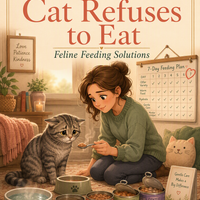

What to Do When Your Cat Refuses to Eat: Feline Feeding Solutions — A Comprehensive Guide to Recognizing, Assessing, and Responding to Feline Anorexia Before Hepatic Lipidosis Develops
A cat that stops eating is a medical emergency in slow motion. Hepatic lipidosis — a potentially fatal liver condition — can develop in as little as 48 hours. Every missed meal counts.
It begins quietly. The bowl sits untouched. You assume your cat is being picky. You decide to wait and see. By day three, you're worried. By day four, you're panicked. What you may not realize is that a metabolic cascade has already begun inside your cat's body. Unlike dogs, cats cannot simply "live off their fat stores" for days. Their unique obligate carnivore metabolism means that within 48 to 72 hours of complete anorexia, fat begins accumulating in the liver — a self-perpetuating cycle that can be fatal without aggressive intervention.
What to Do When Your Cat Refuses to Eat is your comprehensive manual for understanding, assessing, and responding to feline anorexia, grounded in AAFP, ISFM, and ACVIM guidelines. Built around a clear diagnostic framework — is your cat not eating because they cannot eat, will not eat, or do not want to eat this specific food? — this guide gives you the exact steps to take at every stage.
Inside you'll find:
The obligate carnivore metabolism explained — why cats can't down-regulate protein breakdown like dogs, and why their livers are uniquely vulnerable
Hepatic lipidosis — the full pathophysiology, warning signs (including the crucial jaundice signal), treatment, and why early intervention makes the difference between recovery and tragedy
The Three-Track Diagnostic Framework — medical barriers, behavioral/environmental barriers, and food-related barriers, with guidance on when multiple tracks overlap
The Anorexic Cat Assessment — a systematic 5-domain home evaluation tool you can perform today
Medical causes deep dive — dental pain (FORLs, stomatitis, fractured teeth), GI disease (pancreatitis, IBD, linear foreign bodies), systemic disease (CKD, hyperthyroidism, diabetes, cancer), and the pain-anorexia connection
Stress, environment, and behavior — multi-cat feeding dynamics, routine disruption, post-procedure anorexia, and the hospitalized cat
Food aversion and palatability science — why cats develop lasting aversions, how temperature/texture/aroma/umami drive appetite, whisker fatigue, and safe diet transitions
The Intervention Escalation Ladder — 5 tiers from gentle home tweaks to the life-saving feeding tube: Tier 1 (warming food, flat plates, quiet location) → Tier 2 (bonito flakes, tuna juice, nutritional gels) → Tier 3 (mirtazapine, capromorelin) → Tier 4 (veterinary-guided syringe feeding) → Tier 5 (NE and E-tubes — why a feeding tube is compassionate, not cruel)
The 7-Day Appetite Stimulation Protocol — day-by-day guidance from first assessment through veterinary workup to consolidation
The chronically ill cat, the end-of-life cat, and the recovering cat — how the approach changes when the stakes are different
6 printable appendices — assessment checklist, food & symptom diary, palatability enhancer guide, assisted feeding protocol, veterinary communication script, and FAQs
This guide reframes the feeding tube not as a last resort but as what it truly is: a compassionate, effective, often temporary intervention that can mean the difference between recovery and death. It also provides a script for exactly what to say when you call your vet — because when you're panicked, you won't remember.
The clock is ticking from the first missed meal. Early intervention saves lives. Start here.
Customer Reviews
See why hundreds love this product and trust us.