
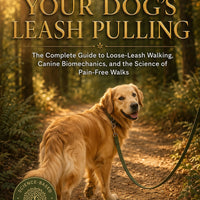
Stop Dog Pulling on Leash | The Complete Loose-Leash Walking Guide: Canine Biomechanics & the Science of Pain-Free Walks – Kitten Realm
Why Does My Dog Pull on the Leash?
"Leash pulling is not disobedience — it is a biomechanical mismatch. A dog's natural walking pace is 2-3x faster than a human's, and the Opposition Reflex — an involuntary survival response to pressure — transforms every taut leash into a tug-of-war the dog is neurologically programmed to win." — AVSAB & Veterinary Biomechanics Research Consensus.
THE ONLY LOOSE-LEASH TRAINING GUIDE GROUNDED IN CANINE BIOMECHANICS.
Stop Dog Pulling on Leash — The Definitive Science-Based Guide
How to Stop Your Dog from Pulling: A Complete Loose-Leash Walking System.
Are you asking yourself: "How do I stop my dog from pulling on the leash?" — every single walk? Do you dread the shoulder strain, the choking sounds, and the embarrassment of being dragged down the street? Your dog is not dominant, stubborn, or trying to be the "alpha." They simply walk faster than you, and no one has ever taught them that slack = reward.
This Masterclass-level manual delivers a complete no-pull training protocol grounded in canine biomechanics and behavioral neuroscience. We address the three root causes no other guide covers together: the Opposition Reflex (why pulling back makes it worse), the Gait-Speed Mismatch (why your pace triggers pulling), and the Reinforcement History (why your dog has been accidentally rewarded for pulling for years). This guide transforms the leash from a battle rope into a communication line — turning painful, frustrating walks into the calm, connected experience you both deserve.
What You'll Learn — A Complete Loose-Leash Walking Curriculum
- Why Does My Dog Pull? — The Biomechanics of Leash Pulling Explained: Understand the gait-speed gap between human and canine locomotion, and why every step you take at human pace creates a tension loop your dog is physically incapable of avoiding without training.
- The Opposition Reflex — What It Is and How to Stop It: A deep dive into the survival reflex that makes dogs pull harder when you pull back — and the neuroscience-backed protocol to short-circuit it without force, prong collars, or choke chains.
- Teaching Loose-Leash Walking — The Core Protocol: Step-by-step instructions for building the "Reinforcement Zone" — the exact position beside you where walking on a slack leash becomes the most rewarding place in the world. Includes marker timing, reward placement, and distraction-proofing.
- The Premack Principle for No-Pull Training: How to harness your dog's natural desire to sniff, explore, and move freely as the ultimate reward for walking politely — turning instinct into training fuel.
- Stopping Leash Pulling in High-Distraction Environments: The Progressive Distance Ladder — a structured system to move from indoor foundations to busy streets, parks, and dog-heavy environments without regression.
- Emergency Protocols for Sudden Pulling: The "Be a Tree" technique, the "180-Degree Pivot," and the "Penalty Yard" reset — three field-tested maneuvers for when pulling resurfaces mid-walk.
Professional Tools & Training System Included (Appendices):
This is a complete dog leash training system, not just a book. Every protocol comes with measurement tools so you can track real progress:
- Appendix A: Daily Loose-Leash Training Log — track duration, distraction level, and % slack-leash time per session.
- Appendix B: Trigger & Environment Mapping Worksheet — identify what triggers pulling and build distraction-graded training routes.
- Appendix C: Reinforcement Zone Timing Chart — precise reward-delivery calibration for optimal learning speed.
- Appendix D: High-Value Trail Mix Recipe Card — 5 DIY reward blends that outperform store-bought treats for attention in the field.
- Appendix E: No-Pull Equipment Fit Guide — harness types, leash lengths, and how the wrong gear silently sabotages your training progress.
Stop searching "how to stop dog pulling on leash" and start the protocol that actually works. Reclaim calm, pain-free walks — no aversive tools, no dominance theory, no fighting your dog's biology. Join thousands of dog owners who chose biomechanics over battle, and science over struggle.
Customer Reviews
See why hundreds love this product and trust us.