
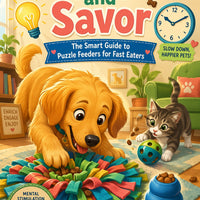

Slow Down and Savor — What If the Bowl Was the Problem, Not the Dog?
[Kitten Realm SCIENTIFIC INSIGHT] Why do dogs who gulp their food in 30 seconds develop both medical and behavioral problems? Because the standard food bowl bypasses the seeking system — the dopamine-driven neural circuit that activates during foraging, searching, and problem-solving. When food appears effortlessly, the brain receives nutrition but no fulfillment. Glen Jensen's contrafreeloading experiments demonstrated this in rats in 1963; subsequent research confirmed it in dogs, cats, primates, and humans. Puzzle feeders engage the seeking system. Sniffing reduces cortisol. Licking releases endorphins. And slowing consumption reduces the risk of gastric dilatation-volvulus (bloat) — an acutely life-threatening emergency. DIRECTLY IMPLEMENTED IN THIS GUIDE.
Feed the Brain, Not Just the Belly.
Slow Down and Savor is not a gimmick catalog. It is a comprehensive, evidence-based guide to enrichment feeding for dogs and cats, organized into four parts with 17 chapters, 5 printable appendices, and a practical 7-day rotation schedule. It covers commercial products, five DIY puzzles you can build for pennies, and a full troubleshooting section for frustration, destruction, and disinterest.
What's Inside:
Part I — The Case for Puzzle Feeding (Chapters 1–3): The problem with the bowl — bloat risk (GDV), digestive strain, and the behavioral vacuum created when a meal lasts 30 seconds. Contrafreeloading and the foraging instinct — why animals consistently prefer to work for food, and the neurobiology of the seeking system. Safety assessment — resource guarding, dental disease, mobility limitations, and species-specific considerations for cats.
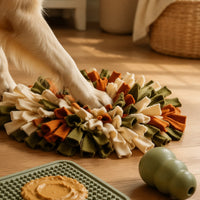
Part II — Product Guide (Chapters 4–9): Snuffle mats and foraging rugs (nose work, calming, all skill levels). Kongs and hollow toys (stuffing guide, freezing protocol, alone-time strategies). Lick mats and slow feeder bowls (endorphin release, speed reduction). Puzzle boards and interactive feeders (problem-solving, difficulty levels, sequential learning). Treat balls and dispensing toys (physical activity, adjustable difficulty). A comparison table with difficulty ratings, price ranges, and best-use recommendations.
Part III — DIY Puzzle Feeders (Chapters 10–14): Five no-cost or low-cost puzzles — the Towel Roll, the Muffin Tin Tennis Ball Challenge, the Cardboard Box Forage Box, the PVC Pipe Treat Dispenser, and the Soda Bottle Spinner. Materials checklists, construction steps, safety notes, and difficulty customization for each.
Part IV — Building Your Enrichment Rotation (Chapters 15–17): A 7-day enrichment rotation schedule with specific puzzle assignments. Introducing puzzle feeders to a novice pet — the three-phase protocol: coexist, trivial success, gradual difficulty. Troubleshooting frustration (make it easier), destruction (choose durable alternatives), and disinterest (upgrade rewards, switch to scheduled meals).
Five Printable Appendices: Full Product Comparison Table (9 products with difficulty, price, durability, cleaning), DIY Materials Checklist, 7-Day Enrichment Rotation Planner, Cleaning and Maintenance Guide, and FAQ covering bloat prevention, unsupervised use, and cat-specific puzzle feeding.
Why Choose This Guide? It is the only puzzle feeder guide that grounds every recommendation in the scientific literature on contrafreeloading, the seeking system, cortisol reduction through sniffing, and endorphin release through licking — while addressing both dogs and cats, both commercial and DIY options, and the critical distinction between enrichment feeding and the medical risk of bloat. Not "buy this toy because it's cute." Not "just scatter some kibble." Evidence-based. Species-appropriate. Actually works.
Customer Reviews
See why hundreds love this product and trust us.