
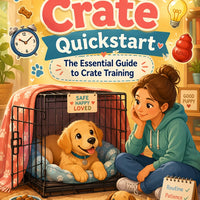

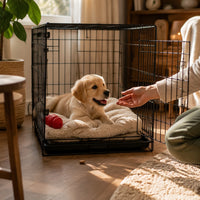
Puppy Crate Quickstart — What If a Crate Wasn't a Cage But a Den?
[Kitten Realm SCIENTIFIC INSIGHT] Why do puppies cry in crates — and why does "cry it out" backfire? Because distress vocalization in a baby animal separated from its littermates is not a protest against confinement. It is a biologically encoded survival response. The den instinct is real: canids seek small, enclosed spaces for safety and deep sleep. But when the crate is introduced with force or isolation, the amygdala encodes it as a threat, not a refuge. AVSAB, AAHA, and ACVB guidelines are unanimous: positive association, gradual duration-building, and preempting needs produce crate-trained dogs. Force and punishment produce crate-phobic dogs. DIRECTLY IMPLEMENTED IN THIS GUIDE.
A Crate Is Not a Cage — It's a Den.
Puppy Crate Quickstart is not a "let them cry it out" manual. It is a structured, 14-day, force-free training plan grounded in the den instinct, operant conditioning, and the published guidelines of the American Veterinary Society of Animal Behavior, the American Animal Hospital Association, and the American College of Veterinary Behaviorists. It explicitly rejects aversive tools, punishment, and the use of the crate as a time-out space, and it teaches owners to distinguish normal adjustment from confinement distress and clinical separation anxiety — three conditions often conflated with dangerous consequences.
What's Inside:
Part I — Understanding the Crate (Chapters 1–4): The den instinct — why crate training leverages a genetically encoded drive, not a learned behavior. Crate selection — wire, plastic, and soft-sided options with a sizing guide (Appendix C) that prevents both cruel confinement and housetraining sabotage. Crate setup — location, bedding, covers, exclusive crate toys, and the critical safety rule of removing collars. The essential differential diagnosis: normal crate adjustment vs. confinement distress vs. separation anxiety — misdiagnosing one as another can worsen the problem.
Part II — The 14-Day Crate Training Plan: Day 1–3 (Open Door): random treat fairy, meals migrating deeper into the crate, special crate-only chews, voluntary nap association. Day 4–6 (Closing the Door): door closes then immediately opens, building duration from 1 second to 10 minutes, introducing brief out-of-sight moments. Day 7–10 (Out of Sight): 30-minute sessions with intermittent presence, varying routine and context, the first short alone period outside the house. Day 11–14 (Consolidation): crating during normal household activity, a practice outing, and a review-and-adjust checkpoint. Every phase includes explicit troubleshooting — what to do when your puppy whines, when to slow down, and how to know you're moving too fast.
Part III — Integrating the Crate into Daily Life (Chapters 5–8): A complete puppy daily schedule template (Appendix B) — wake, potty, meal, play, nap cycles. Overnight crating — crate by the bed, warm water bottle, heartbeat toys, preemptive potty breaks. Daytime crating — balancing confinement with enrichment, using the crate proactively for naps when the puppy is overtired. The Bladder Capacity Formula — one hour per month of age plus one, with explicit age-by-age intervals.
Part IV — Troubleshooting and Transitions (Chapters 9–11): Whining, barking, accidents, and refusal — each with specific, force-free solutions. The transition to free roam — a graduated protocol from 5 supervised minutes to full unsupervised freedom, with a readiness checklist (Appendix E). The crate for life — car travel safety, vet visit stress reduction, emergency evacuation readiness.
Five Printable Appendices: 14-Day Plan at a Glance, Puppy Daily Schedule Template, Crate Size Selection Guide, Troubleshooting FAQ Quick Reference, and Free-Roam Readiness Checklist.
Why Choose This Guide? It is the only crate training manual that aligns every protocol with AVSAB/AAHA/ACVB guidelines, explicitly rejects the "cry it out" method and all aversive approaches by name, and provides the critical differential diagnosis between normal adjustment, confinement distress, and separation anxiety. Not "toughen up your puppy." Not "let them cry themselves to exhaustion." Force-free. Evidence-based. Actually works.
Customer Reviews
See why hundreds love this product and trust us.