
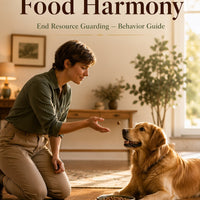
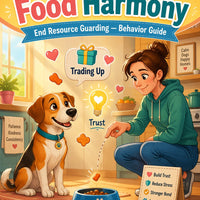

Mastering Food Harmony — What If Your Dog's Growl Was a Cry for Help, Not a Move for Power?
[Kitten Realm SCIENTIFIC INSIGHT] Why is "showing them who's boss" the most dangerous response to resource guarding? Because guarding is a distance-increasing signal rooted in survival-driven fear, not a bid for dominance. Punishing a growl suppresses the warning signal without addressing the underlying anxiety — creating a dog that may skip the growl and go directly to a bite. Modern behavior science (AVSAB/IAABC/ACVB) prioritizes non-confrontational modification: management to stop rehearsal, counterconditioning to change the emotional state from fear to anticipation, and systematic desensitization to build a new reinforcement history. DIRECTLY IMPLEMENTED IN THIS GUIDE.
From Guarding to Giving.
Mastering Food Harmony is a comprehensive, non-confrontational guide to understanding and resolving resource guarding in dogs. Organized into five parts with 18 chapters and 5 printable appendices, it provides a structured framework for assessing severity, implementing life-saving management, and following a methodical behavior modification protocol that replaces defensive aggression with joyful cooperation.
What's Inside:
Part I — The Nature of Resource Guarding (Chapters 1–4): Definition beyond the food bowl (toys, stolen items, spaces, people). Emotional roots — fear, scarcity, and genetics. The guarding spectrum: from freezing and eating faster to stiffening, growling, and biting. Why traditional "alpha" advice fails and how confrontation escalates risk.
Part II — Assessment & Management (Chapters 5–7): The Resource Guarding Assessment (Appendix A) — determining mild, moderate, or severe status. Critical red flags for professional referral (ACVB/IAABC). Management protocols: secure separate feeding spaces, restricting access to triggers, and eliminating competition in multi-pet households.
Part III — Foundation Skills (Chapters 8–10): Three core training pillars: "Drop It" as a joyful trade, not a theft; "Leave It" as a game of impulse control; and "Trading Up" — the foundational technique of pairing approach with high-value reinforcement.
Part IV — Modification Protocol (Chapters 11–14): Structured training plans for mild and moderate cases using counterconditioning and desensitization. Step-by-step progressions for decreasing distance thresholds and building a conditioned emotional response (CER). How to support severe cases with a treatment team.
Part V — Special Considerations (Chapters 15–18): Managing inter-dog guarding in multi-pet homes. Children and safety — why management must be absolute. Guarding spaces (beds/couches) and people. Long-term maintenance and monitoring a lifetime of trust.
Five Printable Appendices: Resource Guarding Assessment Checklist, Daily Training Log, Trading Up Log, Professional Referral Guidelines (DACVB/CDBC), and FAQ addressing emergency situations, "cures," and hand-feeding myths.
Why Choose This Guide? It is the only resource guarding manual that explicitly rejects all forms of physical and verbal intimidation, grounds every protocol in the professional standards of AVSAB/IAABC/ACVB, and provides specific structured plans based on assessment severity. It doesn't just manage the behavior — it heals the fear. Not "be the boss." Not "take the bowl." Evidence-based. Compassionate. Actually works.
Customer Reviews
See why hundreds love this product and trust us.