
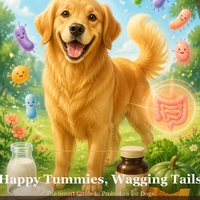


Happy Tummies, Wagging Tails: The Complete Canine Probiotics Guide
There is a revolution happening in veterinary medicine, and it centers on a part of your dog's body that you have probably never thought much about.
Your dog is not a single organism. They are a walking ecosystem — a superorganism composed of trillions of microorganisms living in an intricate, mutually dependent relationship within their gastrointestinal tract. The collective genome of these microbes contains roughly one hundred times more genes than the canine genome itself. This vast, complex, delicately balanced ecosystem — the microbiome — is now understood to be one of the most important determinants of your dog's overall health. It influences not only digestion, but immune function, allergic disease, mood and behavior, skin health, and even the risk of chronic conditions like obesity and diabetes.
When the microbiome is healthy and diverse, your dog thrives. When it is disrupted — a state called dysbiosis — the consequences ripple through every system in their body. The gut barrier becomes permeable ("leaky gut"), allowing bacterial products and partially digested food proteins into the bloodstream to trigger systemic inflammation. The immune system becomes dysregulated. Beneficial bacteria are depleted, and opportunistic pathogens fill the vacuum. Your dog may develop diarrhea, constipation, bloating, or vomiting. They may develop food sensitivities or allergic skin disease. They may become anxious or lethargic. And the single most common cause of acute, severe dysbiosis is sitting in your medicine cabinet right now: antibiotics.
Happy Tummies, Wagging Tails is a comprehensive, science-based manual for understanding and using probiotics — one of the most accessible and evidence-based tools we have for supporting the canine microbiome. Grounded in the guidelines of the American Veterinary Medical Association (AVMA), the American Animal Hospital Association (AAHA), and the World Small Animal Veterinary Association (WSAVA), this guide cuts through marketing claims to deliver what the research actually says. Probiotics are not a cure-all, but when used correctly — the right strains, at the right dose, for the right condition — they can significantly improve digestive function, reduce inflammation, modulate the immune response, and restore balance to a disrupted ecosystem.
Inside, you'll learn how to:
- Understand the microbiome at a cellular level: the ten-to-one ratio of microbial to canine cells, the structured ecosystem from stomach to colon, the critical functions of microbial metabolism including vitamin production (B vitamins, vitamin K), short-chain fatty acid synthesis (butyrate, acetate, propionate), immune training in the gut-associated lymphoid tissue (GALT), and pathogen defense through competitive exclusion
- Trace the gut-health axes that connect the digestive system to every organ: the gut-brain axis (via the vagus nerve and neurotransmitter production — 90% of serotonin is made in the gut, not the brain), the gut-immune axis (70% of immune cells reside in the GALT), the gut-skin axis (why dogs with chronic skin issues almost always have underlying gut dysbiosis), and the gut-metabolic axis (linking the microbiome to obesity and insulin resistance)
- Diagnose dysbiosis — the collapse of the microbial ecosystem — through its many faces: acute devastation from broad-spectrum antibiotics (the "carpet-bombing" of the microbiome), chronic erosion from highly processed low-fiber diets, stress-induced shifts in gut motility and immunity, disease-driven imbalances (IBD, EPI, cancer), and the age-related decline in microbial diversity
- Build a puppy's microbiome for life: the three critical inoculation windows (birth canal, nursing with maternal milk containing beneficial bacteria and prebiotic oligosaccharides, and weaning to solid food), why cesarean-born puppies start at a disadvantage, and why probiotic support during and after antibiotic treatment in puppies carries lifelong implications for allergic disease risk
- Define probiotics with scientific precision using the WHO definition — live microorganisms administered in adequate amounts that confer a demonstrated health benefit — and understand the five key mechanisms: competitive exclusion, antimicrobial production (bacteriocins, organic acids), intestinal barrier strengthening (tight junction proteins), immune modulation via GALT interaction, and beneficial metabolite production
- Navigate the complete strain-by-strain guide: Lactobacillus acidophilus (lactic acid production, pH lowering, pathogen inhibition), L. rhamnosus GG (one of the most researched strains globally — reduces acute diarrhea duration, prevents antibiotic-associated diarrhea, modulates immunity), L. plantarum (anti-inflammatory, excellent gastric survival), Bifidobacterium animalis (reduces diarrhea, improves stool consistency, modulates atopic dermatitis), B. longum (gut barrier integrity, anti-inflammatory), Enterococcus faecium SF68 (decades of veterinary use, hardy and well-studied), and Bacillus subtilis/coagulans (spore-forming, extraordinarily stable through manufacturing and stomach acid)
- Master CFU — colony-forming units: the typical therapeutic range (1-10 billion CFU/day), escalated dosing for acute conditions (20-50 billion), and why the CFU count guaranteed at expiration matters far more than the count at manufacture
- Distinguish spore-forming from non-spore-forming probiotics: why Bacillus species survive heat, acid, shelf time, and even food extrusion, making them ideal for commercial foods and treats, while Lactobacillus and Bifidobacterium require microencapsulation and often refrigeration — and when each type is the better choice
- Treat antibiotic-associated diarrhea — one of the strongest-evidence applications in the probiotic literature — with the correct protocol: administer probiotics at least two hours apart from the antibiotic dose, continue for 2-4 weeks after the antibiotic course ends, and understand why concurrent administration maintains a more normal microbial community during the assault
- Manage chronic digestive conditions (IBD, lymphocytic-plasmacytic enteritis, chronic colitis) with probiotics as a component of multi-modal therapy alongside dietary management (highly digestible, novel protein, or hydrolyzed protein diets) and, when necessary, medical immunosuppression
- Modulate atopic dermatitis through the gut-skin axis: how probiotics shift the immune response from a pro-inflammatory Th2-dominant allergic cascade toward regulatory T-cell-mediated tolerance, potentially reducing pruritus, improving skin barrier function, and decreasing corticosteroid dependence
- Navigate the gut-brain axis for anxious dogs: the emerging field of psychobiotics — strains including L. rhamnosus and B. longum that influence neurotransmitter production and may reduce anxiety-related behaviors and stress-induced GI symptoms
- Read a probiotic label like a professional: full genus-species-strain identification, guaranteed CFU at expiration, third-party verification including the NASC seal, gastric survivability information, and the red flags — missing strain designations, artificial fillers, and extravagant unsubstantiated claims
- Compare major probiotic brands side by side: FortiFlora (Purina — E. faecium SF68, 1×10⁸ CFU, no prebiotics), Proviable-DC (Nutramax — 7 strains, 5×10⁹ CFU, includes FOS prebiotic), Visbiome (ExeGi — 8 strains, 1.125×10¹¹ CFU), and raw goat milk options (Primal, Answers — naturally occurring, variable CFU)
- Extend the picture beyond probiotics: prebiotics as fuel (FOS from chicory root, MOS from yeast cell walls, inulin — and dietary sources like pumpkin, sweet potato, and asparagus), postbiotics as the metabolites that do the actual work (SCFAs, bacteriocins), synbiotic formulations, and multi-strain products (when "more strains" helps versus when it just means lower doses of each)
- Incorporate food-sourced probiotics intelligently: plain yogurt and kefir (live active cultures, species-appropriate serving sizes), raw fermented vegetables (sauerkraut, kimchi — with critical safety caveats about onion, garlic, and salt), raw goat milk (often tolerated by lactose-sensitive dogs), and why these should complement, not replace, targeted probiotic supplements
- Execute the practical 7-Day Gut Health Protocol: Days 1–2 (diet audit, baseline stool/symptom recording), Days 3–5 (half-dose probiotic introduction with prebiotic food — cooked pumpkin or sweet potato — and monitoring for transient GI adjustment), Days 6–7 (full-dose assessment, response evaluation, and individualized long-term planning)
- Address special populations: the senior dog's declining microbial diversity and the importance of Bifidobacterium species, the performance dog's gut challenges from intense exercise, travel stress, and water changes, and the dog on long-term medication (NSAIDs, steroids, chemotherapy) requiring careful gut monitoring
- Build a gut-healthy lifestyle beyond supplementation: species-appropriate diet as the non-negotiable foundation, regular exercise for healthy motility, stress reduction through routine and environmental safety, and antibiotic stewardship
Plus five printable appendices including the Strain-by-Strain Benefits Quick-Reference Table (8 strains with evidence levels and dosing), the Probiotic Product Comparison Table (5 products with CFU, prebiotic status, and cost ratings), the 7-Day Gut Health Protocol Tracker, the Food-Sourced Probiotic and Prebiotic Guide (7 foods with serving sizes and notes), and an expanded Frequently Asked Questions section.
This guide is for you if:
- Your dog has just finished a course of antibiotics and you're watching them struggle with diarrhea, knowing their gut has been carpet-bombed
- Your dog has chronic digestive issues — soft stools, gas, bloating, rumbling tummy — and you've tried multiple foods without lasting results
- Your dog licks their paws raw or scratches constantly, and you're beginning to suspect the root cause might be deeper than their skin
- You've stood in the pet store staring at a wall of probiotic products, completely overwhelmed by strains, CFU counts, and marketing claims
- You want to understand the science — not just product recommendations — so you can make informed decisions for your dog's entire life
- You believe that gut health is the foundation of overall health, and you're ready to build that foundation systematically
Your dog's gut is the foundation of their health. When the gut is thriving, the dog is thriving. Happy tummy, wagging tail. This guide gives you the knowledge and the tools to support that foundation for a lifetime.
Your brain is not broken. It is overprotective.
Kitten Realm Press | kittenrealm.com
Customer Reviews
See why hundreds love this product and trust us.