
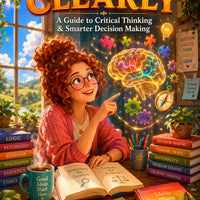

Critical Thinking Guide — Think Clearly
KITTEN REALM SCIENTIFIC INSIGHT
Why do smart people make terrible decisions — and why does "just think harder" never fix it?
Here is what is actually happening inside your head when you make a bad call.
Your brain runs on two systems. System 1 is fast, automatic, and effortless — it makes snap judgments, recognizes patterns, handles 95% of your daily decisions without you noticing. System 2 is slow, analytical, and deliberate — it solves math problems, weighs pros and cons, considers consequences. The problem is not either system. The problem is the handoff.
When System 1 encounters a situation it was not designed for — a complex negotiation, a statistical risk, a career-defining choice — it generates an answer that feels right but is systematically wrong. System 2, lazy and easily fatigued, endorses it without checking. This is the architecture of every cognitive bias. Confirmation bias is System 1 finding evidence for what you already believe and System 2 nodding along. Anchoring is System 1 latching onto the first number it sees and System 2 adjusting too little. The availability heuristic is System 1 mistaking vividness for probability and System 2 not bothering to look up the base rate.
This is not a character flaw. It is not low IQ. It is cognitive design — your brain running on savannah-era software in a modern world. And design can be redesigned.
Most "thinking" books give you principles. They tell you biases exist. They don't give you a protocol to fix them. That is education — not recalibration.
Think Clearly is a protocol. Twenty-eight chapters. Six parts. Each one a targeted cognitive intervention. By the end, you are not just aware of your mental bugs — you have a toolkit that catches them in real time.
WHAT'S INSIDE
PART I — Foundations (Chapters 1–4). System 1 and System 2 — the two engines of thought, explained with Kahneman's framework. Intellectual humility as the starting point of all clear thinking. First principles thinking — break problems down to bedrock instead of reasoning by analogy.
PART II — Cognitive Biases (Chapters 5–11). Forty-plus biases, organized by family so you actually remember them. Confirmation bias family. Anchoring and availability family. Social bias family (groupthink, authority bias, halo effect). Probability and risk family (why humans are terrible at statistics). Hindsight and narrative family (how you fool yourself after the fact). Each family ends with debiasing strategies. Knowing about a bias does not make you immune. These strategies do.
PART III — Argument Analysis (Chapters 12–15). Dissect arguments into premises and conclusions. Identify logical fallacies — ad hominem, straw man, false dilemma, and twelve more, with a full quick-reference in Appendix B. Steel-man opposing views instead of attacking straw men. Evaluate sources for credibility, accuracy, and objectivity.
PART IV — Decision Frameworks (Chapters 16–20). The WRAP model (Widen, Reality-test, Attain distance, Prepare) — four countermeasures for four decision villains. The Cynefin framework — match your approach to the problem type or your solution makes it worse. Second-order thinking — "And then what?" Pre-mortems and red teaming — stress-test your plans before launch. Decision matrix analysis — compare options systematically instead of going with your gut.
PART V — Probabilistic Thinking (Chapters 21–25). The single most powerful upgrade to your cognition. Think in probabilities instead of binaries. Update your beliefs with Bayesian reasoning when new evidence arrives. Anchor your estimates in base rates — the most neglected information in human judgment. Calculate expected value for decisions under uncertainty. Recognize fat-tailed distributions where extreme events are far more common than normal models predict. Annie Duke's poker-vs-chess metaphor anchors this section: life is poker, not chess. Good decisions can have bad outcomes. Evaluate the process, not the result.
PART VI — The Lifestyle (Chapters 26–28). The Decision Journal — the single most impactful habit for improving your thinking over time. Record reasoning before outcomes. Review. Calibrate. Daily practices for building the critical thinking muscle. How to foster critical thinking in teams: leaders speak last, devil's advocates are assigned, pre-mortems are mandatory.
Appendices. Encyclopedia of 40+ cognitive biases with definitions. Logical fallacies quick-reference guide. Decision Journal template. The critical thinker's reading list — Kahneman, Duke, Taleb, Tetlock, Galef, and more.
THE SCIENCE
Built on Daniel Kahneman and Amos Tversky's Nobel Prize-winning research on heuristics and biases. Anchored in Annie Duke's decision science, Charlie Munger's mental models, Philip Tetlock's superforecasting research, and Julia Galef's scout mindset framework. This is not philosophy. This is applied cognitive science. Evidence-based. No vague advice.
THIS IS FOR YOU IF:
▸ Your decisions feel reactive — you realize the mistake after, not before ▸ You consume information but struggle to evaluate whether it is true ▸ You know biases exist but have no system to catch them in real time ▸ You want a curriculum, not scattered blog posts and YouTube videos ▸ You value evidence over opinion, structure over randomness
THIS IS NOT FOR YOU IF:
✗ You want a quick fix — cognitive rewiring takes practice. There is no magic ✗ You want to feel good about your thinking rather than challenge it ✗ You expect certainty — this book teaches probability, not false confidence
Your brain is wired for shortcuts. Those shortcuts systematically mislead you. This book is the override. Start Chapter 1 tonight.
Customer Reviews
See why hundreds love this product and trust us.