
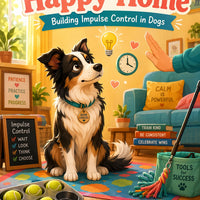

Calm Canine, Happy Home — What If Your Dog's Reactivity Wasn't Disobedience But a Brain Not Yet Trained to Pause?
[Kitten Realm SCIENTIFIC INSIGHT] Why does punishment fail to build impulse control? Because reactivity bypasses the prefrontal cortex entirely — when a trigger activates the amygdala, the thinking brain goes offline. Punishment adds more fear to an already flooded system. The neural alternative is strengthening the prefrontal-amygdala pathway through thousands of rewarded repetitions of self-control: backing away from a treat (It's Yer Choice), waiting at a threshold (Wait), disengaging from temptation (Leave It), and choosing calm over chaos (Default Settle). Susan Garrett's It's Yer Choice. Leslie McDevitt's Look at That. Walter Mischel's marshmallow paradigm — applied to canine cognition. DIRECTLY IMPLEMENTED IN THIS GUIDE.
The Calmest Dog Is the Most Free.
Calm Canine, Happy Home is a neuroscience-grounded, force-free training program organized into four parts: the science of self-control, six foundation exercises, five real-world applications, and a gamified 21-day challenge. It teaches dog owners not to suppress behavior, but to build the brain circuits that make thoughtful choices possible.
What's Inside:
Part I — The Science of Self-Control (Chapters 1–3): The canine prefrontal cortex — why impulse control is neuroanatomy, not willpower. Arousal, thresholds, and trigger stacking — why a dog who behaves perfectly at home falls apart on a walk with multiple stressors. A six-scenario impulse control assessment (Appendix A) that identifies priority training areas.
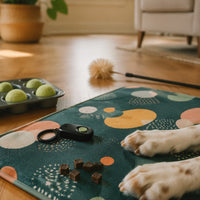
Part II — The Foundation Exercises (Chapters 4–9): Six core protocols: It's Yer Choice (the cornerstone — diving makes treats disappear, backing away makes them appear), Wait (threshold patience — calm opens doors, frantic closes them), Leave It (disengagement from any temptation, generalized across contexts), Default Settle (capturing and reinforcing calmness without cues), Zen Down (building duration and genuine relaxation, not just position), and Mat Training (the portable off-switch that travels anywhere).
Part III — Real-World Applications (Chapters 10–14): Door darting (default wait at every threshold). Counter surfing (mat as incompatible behavior + "four on the floor" reinforcement). Polite greetings (jumping drives away, calm brings closer). Leash reactivity (Look at That game + emergency U-turns). Food grabbing (bowl lowering protocol + gentle mouth game).
Part IV — Games and Maintenance (Chapters 15–17): Five impulse control games (Flirt Pole, Red Light Green Light, Hide and Seek, Tug-and-Drop, Muffin Tin). The 21-Day Impulse Control Challenge with a daily tracker (Appendix C) — Week 1 foundations, Week 2 increased difficulty, Week 3 real-world application. Troubleshooting frustration, regression, and severe reactivity requiring professional referral.
Five Printable Appendices: Impulse Control Assessment Worksheet, Daily Training Log, 21-Day Challenge Tracker, Games Quick-Reference Guide, and FAQ covering generalization, older dogs, and timelines.
Why Choose This Guide? It is the only impulse control manual that grounds every exercise in the neuroscience of the prefrontal cortex–amygdala pathway, explains trigger stacking as the mechanism behind apparent "regression," and provides a full 21-day structured challenge. Not "be more dominant." Not "correct the bad behavior." Evidence-based. Neuroscience-driven. Actually works.
Customer Reviews
See why hundreds love this product and trust us.