
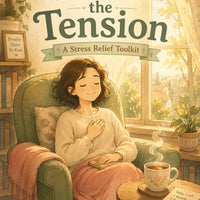
Break the Tension: The Stress Response Interruption Protocol
KITTEN REALM SCIENTIFIC INSIGHT
Your amygdala can't tell the difference between a saber-toothed tiger and a passive-aggressive email.
That pounding heart, that shallow breath, that mental spiral — it's not a personal failing. It's your sympathetic nervous system doing exactly what it evolved to do: flood your body with cortisol and adrenaline, accelerate your heart, and shut down your prefrontal cortex so you can fight, flee, or freeze. The problem is not the response. The problem is that modern life never lets it turn off. Work deadlines. Financial pressure. Social media. Parenting demands. The result is allostatic load — the biological pathway through which chronic stress becomes chronic disease.
Here is what most people don't know: the same nervous system that can be hijacked by stress can also be deliberately calmed. The vagus nerve, the body's primary parasympathetic conduit, responds to specific, measurable inputs — slow breathing, gentle touch, alternating sensory stimulation. When stimulated, it sends a signal to your brain: "Stand down. The body is calm." Heart rate drops. Cortisol falls. The thinking brain comes back online.
This is not mysticism. It is applied physiology. Every technique in Break the Tension works on your body, not your beliefs.
Break the Tension is not a meditation course. It is a toolkit. 15 techniques. 4 categories. 8 real-world scenarios. No philosophy. No backstory. Just what works, when you need it.
WHAT'S INSIDE
PART I — BREATHING (Fastest nervous system access): Box breathing (Navy SEAL vagal activation), 4-7-8 breathing (Dr. Andrew Weil's natural tranquilizer), Nadi Shodhana alternate nostril breathing (brain hemisphere balance), diaphragmatic belly breathing (portable, invisible), the physiological sigh (Dr. Andrew Huberman — fastest arousal reduction known).
PART II — QUICK MEDITATIONS (Cognitive interruption): 3-minute body scan (interoceptive awareness), 5-minute safe place visualization (neuroplasticity-based relaxation), loving-kindness minute (metta for self-criticism), thought labeling practice (ACT cognitive defusion), progressive muscle relaxation (Edmund Jacobson — tension-release contrast).
PART III — GROUNDING TECHNIQUES (Present-moment anchoring): 5-4-3-2-1 sensory grounding (trauma therapy standard), temperature shift cold water reset (mammalian dive reflex), bilateral stimulation butterfly hug (EMDR-based self-soothing), feet on ground + hand on heart, object anchor (conditioned relaxation cue).
PART IV — STRESS FIRST AID KIT (8 scenarios, ready-to-use sequences): At work and can't leave your desk. Social anxiety before an event. Racing thoughts at bedtime. Panic attack building. Anger about to explode. Post-conflict adrenaline crash. Decision fatigue paralysis. General life overwhelm. Each scenario: which techniques, in what order, for how long. Flip to the page. Follow the sequence. Done.
PART V — LONG-TERM RESILIENCE: Vagal tone training through daily practice. Sleep as cortisol regulation. Movement as stress hormone metabolism. Social connection as oxytocin buffer. Stressor audit: what you can control.
APPENDICES: Stress First Aid Quick-Reference Card (print, cut, keep in wallet). 30-Day Practice Log (track morning, midday, evening sessions and stress levels). Full 10-minute Body Scan Script. Recommended reading (Sapolsky, Nagoski, Kabat-Zinn, van der Kolk).
THIS IS FOR YOU IF:
▸ Your stress response is on a hair trigger and you need immediate tools
▸ You've tried "just breathe" and it didn't work — you need the right technique for the right moment
▸ You want a reference manual, not a philosophy book
▸ You need protocols organized by real-life scenario, not by abstract category
THIS IS NOT FOR YOU IF:
✗ You want a single magic technique — there isn't one. This is a toolkit
✗ You need clinical mental health treatment — this is self-regulation, not therapy
Your racing heart is not trying to sabotage you. It is trying to prepare you. The question is: prepared for what? And with these 15 techniques in your hands, the answer is: prepared to pause, to breathe, to choose your response instead of reacting on autopilot. Stress is a physiological response. You can interrupt it.
Customer Reviews
See why hundreds love this product and trust us.