
It usually happens on a Tuesday. You walk into the spare room, or the living room, or the corner of the hallway, and you smell it before you see it: a puddle soaking into the carpet, a neat pile behind the sofa, or a line of small spots along the baseboard. Your cat, who has used the litter box faithfully for years, has suddenly — or so it seems — started peeing and pooping everywhere but the box.
If you are reading this, you are probably feeling a combination of frustration, embarrassment, and fear. You may have already wondered whether your cat is angry at you, whether you should rehome her, or whether you are somehow failing as an owner. Let's get one thing out of the way immediately, because it is the single most important fact in this entire guide:
House soiling — peeing or pooping outside the litter box — is not spite, revenge, jealousy, or a "behavior problem" in the moral sense of the word. It is one of the most common medical and behavioral complaints in veterinary medicine, and it is nearly always solvable.
House soiling is one of the leading behavioral reasons cats are surrendered to shelters in the United States, and studies and behaviorists consistently list it as a top-three complaint in feline practice. That is the bad news. The good news is that the veterinary behavior literature — including the authoritative AAFP/ISFM House Soiling Guidelines and the Cornell Feline Health Center's clinical resources — gives us a clear, stepwise protocol that resolves the overwhelming majority of cases when it is followed properly.
This guide walks you through that protocol in plain language. It is long, because solving house soiling is not a single trick: it is a systematic process of ruling out medical causes, identifying what your cat is telling you with the location and pattern of the accidents, then rebuilding a litter box system and a home environment that your cat actually wants to use.
First, Understand What Is Happening in Your Cat's Brain
Cats are not miniature humans. They do not keep score, they do not plan acts of revenge, and they do not feel guilt in the way we imagine when we discover an accident. What they do have is a highly developed sense of territory, an exquisite sensitivity to smell, a strong preference for predictability, and a nervous system that responds to pain and stress by changing behavior.
When a cat eliminates outside the box, one of four things is almost always true:
- Something hurts. Urinary pain, inflammation, or another medical condition makes the box feel like the scene of the crime, or makes the cat unable to reach it in time.
- Something about the box is unpleasant. The litter hurts her paws, the box is too small or too dirty, the hood traps odor, or the location feels unsafe.
- Something in the environment is stressful. Another cat blocks the hallway; a new baby, a move, construction noise, or a change in schedule has destabilized her sense of control and safety.
- Something about the surface is appealing. Soft carpet, laundry, or a specific corner may simply feel better to a cat who has developed a preference — often because of one of the three reasons above.
Notice that "the cat is being bad" is not on that list. Every accident is information. Your job over the next few weeks is to become a detective, and this guide is your case file.
Step 1: Rule Out Medical Causes First — This Is Not Optional
The single most common mistake cat owners make is assuming the problem is behavioral and skipping the veterinary visit. In reality, a substantial proportion of house soiling cases — and the majority of sudden-onset urination outside the box in adult cats — have a medical component, sometimes with a behavioral component layered on top.
Book a veterinary appointment before you change anything else. Ask specifically for a workup that includes a urine analysis, and discuss whether blood work (a chemistry panel and thyroid test), blood pressure, and imaging are appropriate for your cat's age and history.
Medical conditions that commonly cause house soiling
| Condition | What it is | Typical clues |
|---|---|---|
| Feline lower urinary tract disease (FLUTD) | An umbrella term for bladder and urethral problems, including inflammation of unknown origin | Frequent small urinations, straining, licking the genital area, urinating in new places, sometimes blood |
| Feline interstitial cystitis (FIC) | A stress-linked bladder pain syndrome, common in cats | Episodes that flare with stress; accidents on cool smooth surfaces like sinks and bathtubs as well as soft surfaces |
| Urinary tract infection or crystals/stones | Infection or mineral sediment that irritates the bladder and urethra | Straining, small volumes, discomfort, accidents near (not in) the box |
| Urethral obstruction | A blockage, most common in male cats — a life-threatening emergency | Repeated trips to the box with little or no urine, crying, crouching, restlessness, vomiting, lethargy |
| Chronic kidney disease | Progressive loss of kidney function, very common in older cats | Increased urination and thirst; boxes that are too far away or too small |
| Diabetes mellitus | A hormonal disease causing high blood sugar and increased urine output | Large volumes of urine, increased drinking and appetite, weight change |
| Hyperthyroidism | An overactive thyroid, common in senior cats | Increased urination, weight loss despite a good appetite, restlessness |
| Arthritis and other pain | Joint pain, dental pain, or general discomfort | Hesitation at high-sided boxes, accidents right beside the box, reluctance to climb stairs |
| Gastrointestinal disease or parasites | Diarrhea, inflammatory bowel disease, intestinal worms | Pooping outside the box, urgency, soft or abnormal stool |
| Cognitive dysfunction (feline dementia) | Age-related decline in memory and orientation | Accidents in new spots, confusion, vocalizing at night, changes in sleep-wake cycle |
Emergency warning: If your cat is a male, is repeatedly visiting the box without producing urine, is crying or straining, or you see no urine at all for more than 12–24 hours, treat this as an emergency and call a veterinarian or emergency clinic immediately. A blocked urethra can become fatal within a day or two.
Here is why this step matters so much: pain changes behavior. A cat who associates the litter box with the burning sensation of cystitis will develop a genuine, learned aversion to the box. Even after the medical issue is treated, the aversion can remain — which is why the best outcomes come from treating the medical problem and rebuilding the box experience at the same time.
Step 2: Read the Pattern — Every Accident Is a Clue
Before you clean anything up, take photographs and notes. Where exactly did it happen? Was it urine or stool? Was the cat squatting or spraying (standing, tail quivering, aiming at a vertical surface)? What surface did she choose? Answering these questions can point you toward the right fix faster than any product on the market.
Urine vs. stool
Urine accidents are more often linked to urinary tract pain or litter box aversion. Stool accidents are more often linked to gastrointestinal issues or to a box the cat finds unappealing or hard to access — but both can overlap. If your cat has stopped using the box only for urine but still poops in it (or vice versa), that split is a major clue and should be described in detail to your veterinarian.
Squatting vs. spraying
A cat who squats and deposits urine on horizontal surfaces is usually responding to a box problem or a medical problem. A cat who backs up to a vertical surface — a wall, a door, the side of the sofa, a curtain — stands with a quivering tail, and sprays a small amount is displaying urine marking, a territorial and social communication behavior. Marking is more common in intact cats (both male and female), in multi-cat households, and in homes with outdoor cats visible through windows. Marking and box aversion are treated differently, so this distinction matters.
Location tells a story
- Right next to the litter box: a classic sign of aversion, pain, or a box that is too small, too dirty, too high-sided, or in a scary location.
- On soft surfaces — beds, laundry, towels, rugs: often pain-related or stress-related, because many cats prefer soft, absorbent surfaces when they feel discomfort or insecurity.
- On cool, smooth surfaces — sinks, bathtubs, tile: frequently associated with inflammation in the urinary tract; the coolness may soothe the area.
- On vertical surfaces, doorways, or windows: typical of territorial marking.
- On a specific person's belongings: not revenge — usually a sign of social insecurity or marking of a valued resource, and often tied to household tension.
- In new or random locations, especially in senior cats: think cognitive dysfunction or an inability to navigate to the box in time.
Write all of this down. Your notes will make your veterinary visit far more productive and will guide the environmental changes below.
Step 3: The Litter — Where Most Homes Get It Wrong
Cats are individuals, but the research and clinical guidance are remarkably consistent on a few points. The AAFP/ISFM guidelines and feline behavior specialists repeatedly recommend that the default choice be fine-grained, unscented, clumping litter — the closest thing to the sandy, diggable substrate cats are wired to use.
Choose the texture your cat prefers, not the one you prefer
- Fine clumping litter: the safest default. Diggable, easy to keep clean, and pleasant for most cats.
- Soft, fine substrates (some clumping litters, certain natural litters): often preferred by cats who seem sensitive to texture.
- Pellets, crystals, and coarse materials: usually fine for some cats, but if you are troubleshooting a problem, move away from them first. Many cats find them uncomfortable.
- Wood, corn, wheat, and grass litters: can be excellent for some cats and irritating to others. They are worth a trial during troubleshooting — one at a time, with clean transitions.
Scent is a bigger deal than you think
Remember the fifth pillar of the feline environmental needs guidelines: a cat's environment must respect the importance of smell. Deodorizing litters, perfumed crystals, and citrus- or floral-scented products can be actively unpleasant to a cat, whose sense of smell is many times more sensitive than ours. If there is one change to make today, it is switching to unscented litter.
Depth matters
Most guidelines recommend around 1.5–2 inches (about 3–5 cm) of litter — enough to dig and bury, not so deep that the cat sinks or that cleaning becomes hard. If your cat kicks litter out of the box, a slightly deeper layer plus a high-sided box may help; if she refuses to dig, try a shallower layer.
Run controlled trials
You cannot read a cat's mind, but you can run experiments. When testing a new litter, place two boxes side by side in a neutral location — one with the old litter, one with the new — and count which one she uses over a week. This is the same approach behaviorists recommend for identifying preference, and it turns guesswork into data.
Step 4: The Box Itself — Size, Shape, and Entry
The typical box sold in pet stores is too small for the typical cat. A useful rule of thumb is that the box should be about one and a half times the length of your cat, nose to base of tail. A large plastic storage tub — with a doorway cut into one side — is a favorite among behaviorists precisely because it offers space, low cost, and easy cleaning.
Covered or uncovered?
Uncovered is the safer default, especially in a troubleshooting scenario. Hoods concentrate odor, can feel like a trap in a household with any tension, and tend to be smaller than advertised. Some cats do fine in covered boxes, and some prefer them for privacy in a busy home — but if you are solving a problem, start open and let your cat vote.
Entry shape matters for senior cats
A high-sided box keeps litter in — and can keep an arthritic cat out. Senior cats with joint pain, and cats with any mobility limitation, benefit enormously from a low entry point and a large open box. If your cat has been diagnosed with arthritis or you suspect it, search for "low-entry" or "senior" litter boxes, or use a shallow-sided storage bin and generous litter depth.
Liner, mat, and accessories
- Skip the liner during troubleshooting. Claws snag on plastic liners, and the noise and texture can be off-putting.
- Use a mat outside the box to catch tracked litter; a tidy bathroom is easier to keep clean, and litter tracking can discourage owners from scooping as often as they should.
- Consider a low-traffic, quiet, well-ventilated location. An unfinished basement next to a rumbling furnace is not a pleasant bathroom.
Step 5: Number and Placement — The Unnegotiable Rules
Two rules from the feline environmental needs guidelines should be treated as non-negotiable:
- The "N + 1" rule: one litter box per cat, plus one extra. Two cats = three boxes minimum. Four cats = five boxes. This is not about your cats sharing nicely; it is about resources, and competition for resources is a leading driver of house soiling.
- Separate the resources: boxes should be placed in different locations, not lined up in a single row. Two boxes side by side in the same corner count as one location in a cat's mind. Ideally, each box should be in a separate room or zone, with more than one escape route, away from food and water, and not next to noisy appliances.
Placement checklist
- Quiet: away from washing machines, dryers, dishwashers, and heavy foot traffic.
- Multiple exits: avoid dead-end corners where a cat can feel cornered by a housemate. A box in a closet with one exit is a trap in a multi-cat home.
- One per floor: in multi-story homes, at least one box per level, so a cat does not have to run downstairs past a blocking cat or a toddler's gate to reach the bathroom.
- Never next to food and water: eating and eliminating next to each other contradicts a cat's natural behavior and increases stress.
- Avoid changes without notice: if the box location is fine, don't move it. If you must move it, move it a few inches at a time over several days.
If the only possible location is a spot your cat avoids, add another box rather than relocating the existing one. More boxes in more places solve far more cases than any other change you can make.
Step 6: Cleaning, Odor, and the Chemistry of "Clean Enough"
Cats have an extraordinary sense of smell, and a litter box that smells "clean" to you may still smell used to your cat. Equally important, the way you clean the accidents themselves determines whether those spots become permanent attractions.
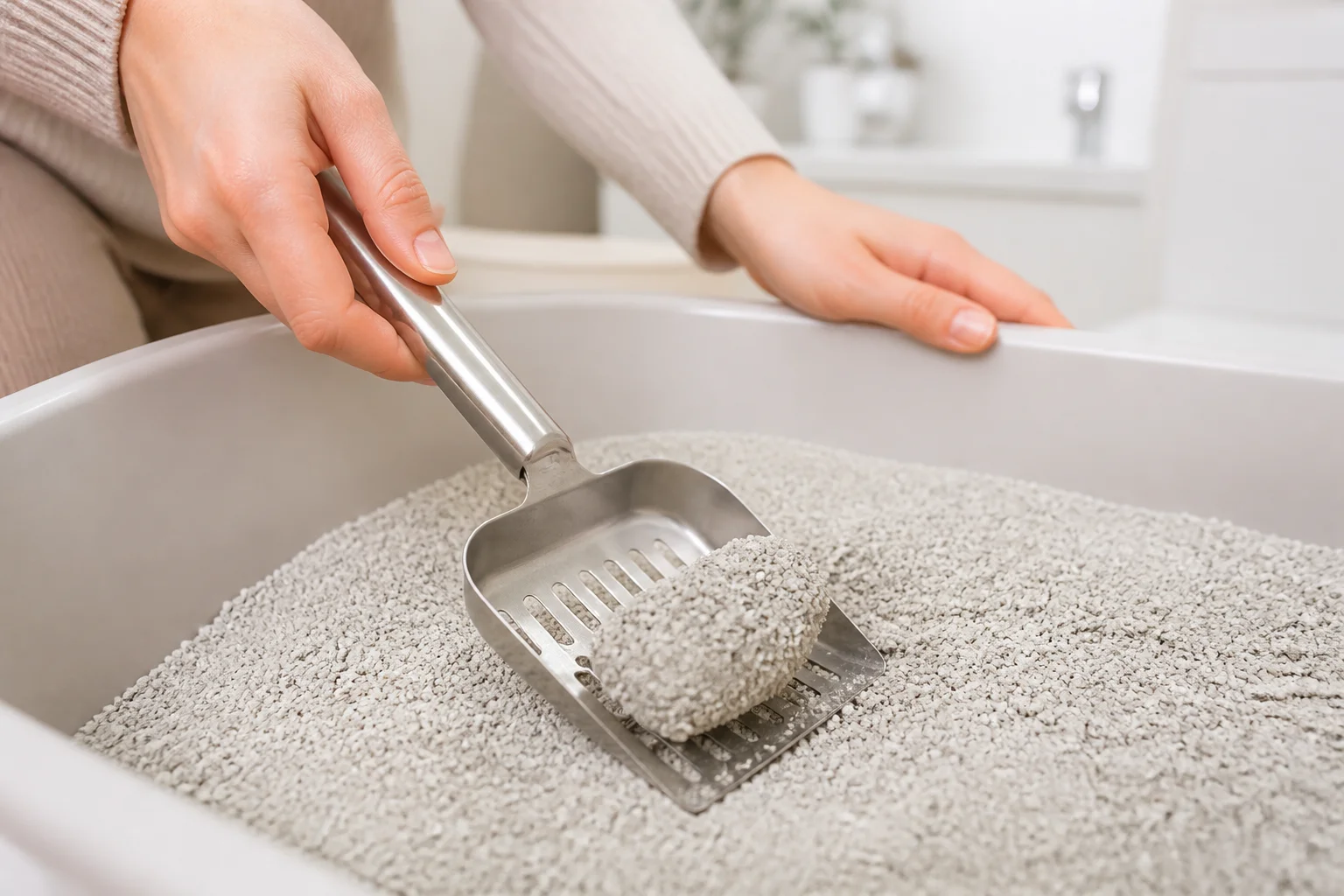
Scoop at least twice a day. The single most common environmental cause of house soiling is a box that is not clean enough by feline standards.
The scooping schedule
- Scoop at least twice daily — morning and evening. Once-a-day scooping is a common trigger, especially in multi-cat homes.
- Top up the litter as you scoop. Cats dislike shallow, bare boxes.
- Full change and wash: every 2–4 weeks for clumping litter (more often in multi-cat homes), scrubbing with a mild, unscented soap and hot water. Avoid strong disinfectants and anything with citrus, bleach, or heavy perfume.
Cleaning accidents properly
Regular household cleaners are not enough. Urine contains proteins and pheromonal compounds that bind to carpet, wood, and upholstery, and they continue to signal "this is a bathroom" for months. What you need is an enzymatic cleaner formulated for pet waste:
- Blot, don't rub. Press a clean cloth or paper towel firmly to lift as much liquid as possible.
- Saturate the spot with the enzymatic cleaner, going slightly beyond the visible stain and down into the padding if possible.
- Let it dwell for the full contact time on the label — usually 10–15 minutes — then blot dry.
- Repeat if needed after it dries. In severe cases, on carpets and sofas, professional cleaning or replacing the affected underlay may be the only way to fully remove the scent signal.
Never use ammonia-based cleaners on cat urine. Ammonia is a component of urine, and using it can make the spot smell more like a toilet, not less. Avoid bleach and strong fragrances for the same reason.
Make the old spots unattractive
- Place a litter box on or near the preferred accident spot once it is fully cleaned. Cats tend to return to the same place, so if you can put a box there, you convert the problem area into a solution area.
- Block or change the function of the spot if a box cannot go there: place a piece of furniture, a bowl of food (cats rarely eliminate where they eat), or a plastic carpet runner nubs-up, which many cats dislike under their paws.
- Keep the door closed to rooms you cannot supervise during the retraining period.
Step 7: Reduce Stress and Restore the Five Pillars
Stress is a genuine physiological trigger for house soiling. It triggers feline interstitial cystitis flares, it disrupts routine, and it can push a cat to mark or to avoid a box that a housemate is guarding. The AAFP/ISFM environmental needs guidelines are organized around five pillars — use them as a checklist for your home:
- A safe place: a private, elevated spot where your cat can retreat and observe without being disturbed — a cat tree, a shelf, a covered bed.
- Multiple, separated key resources: food, water, litter boxes, scratching posts, resting spots, and toys distributed so that no cat must compete or pass another cat to reach them.
- Opportunity for play and predatory behavior: daily interactive play sessions with a wand toy, puzzle feeders, and enrichment that lets your cat stalk, chase, and catch.
- Positive, consistent, predictable human–cat interaction: let your cat initiate contact; use gentle handling; keep routines stable.
- An environment that respects the sense of smell: unscented litter, minimal harsh cleaners and air fresheners, and slow, scent-swap introductions when a new animal enters the home.
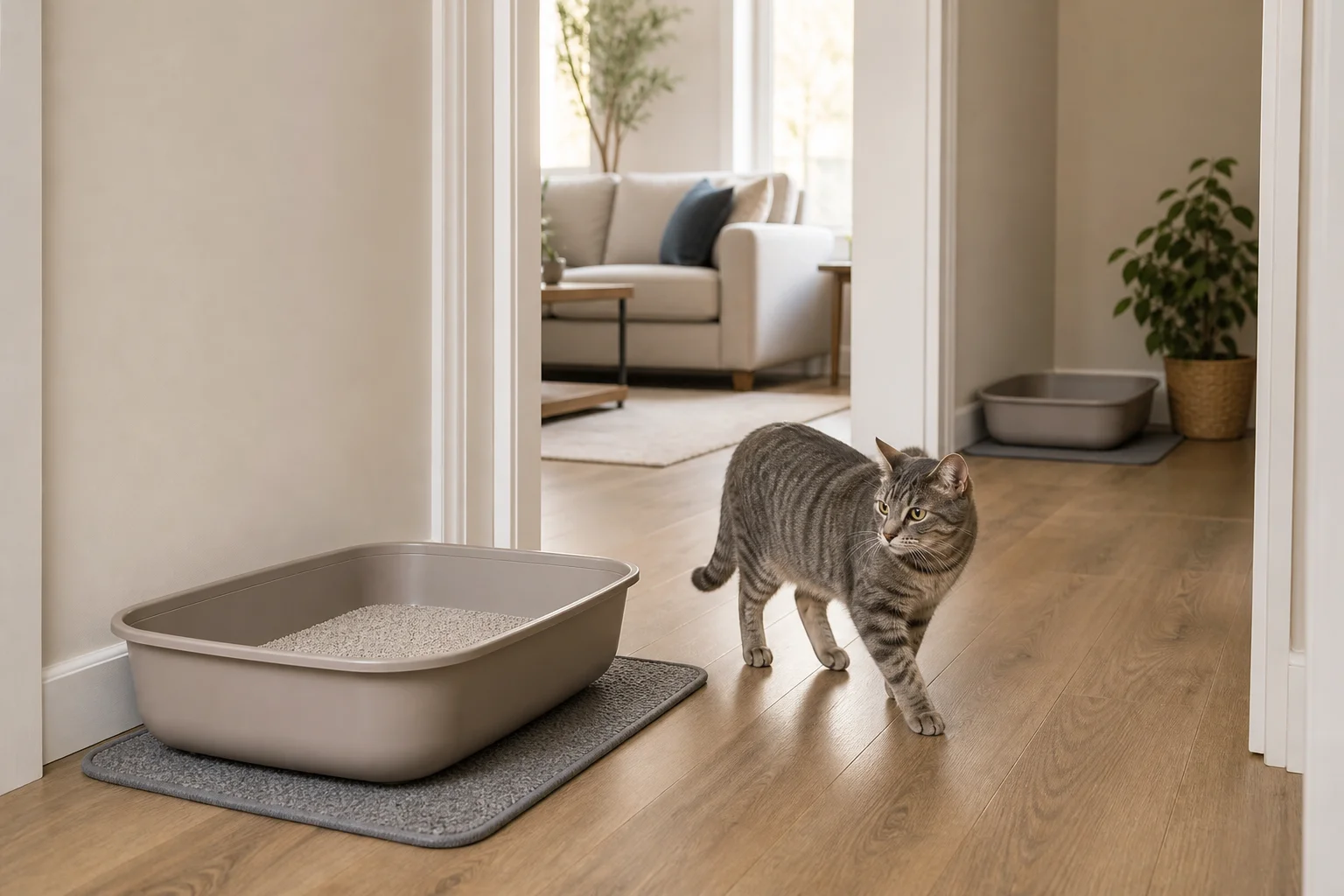
Two boxes in two separate areas of the home, both large, open, unscented, and quiet — the standard setup behaviorists recommend for most households.
Specific stressors to audit
- Multi-cat tension. Bullying is often silent: a cat may simply be blocked from a hallway, or stared at, without any fighting. Add boxes, add vertical space, feed in separate rooms, and consider consulting a behavior professional if tension persists.
- Changes. Moves, renovations, new furniture, a new baby, a new work schedule, guests, and even a new scent on your clothes can destabilize a sensitive cat. Keep changes gradual and maintain routine.
- Outdoor cats. A neighborhood cat visible through a window or glass door can trigger marking. Block the view with frosted film or a curtain, or use a motion-activated deterrent outside.
- Pheromone products. Synthetic feline facial pheromone diffusers and sprays can help reduce stress-related marking and soiling in some cats. They are not a cure on their own, but they are a low-risk addition to a broader plan.
- Litter box "privacy" panels and mats. Avoid enclosed furniture that traps odor and offers no escape route; a simple open box in a quiet corner beats a stylish cabinet every time.
Step 8: The Retraining Protocol — A Four-Week Plan That Works
Once medical causes are addressed, the environment is set up correctly, and stress is being managed, most cats can be retrained. This is the protocol behaviorists typically recommend, adapted for home use:
Week 1: Reset the baseline
- Confine your cat to a small, cat-proofed room — a bathroom or spare bedroom — with everything she needs: food, water, a bed, scratching surface, litter box, and enrichment. This is not punishment; it is a quiet reset that lets you observe patterns and prevents accidents elsewhere.
- Add boxes. Two boxes in this room, in different corners, both large and open, both with unscented fine clumping litter at 1.5–2 inches.
- Clean every accident immediately with an enzymatic cleaner.
- Visit frequently, gently. Sit on the floor, play with a wand toy, offer treats, and let her come to you. Your goal this week is calm predictability.
- Log everything: where she eliminates, at what times, which box she prefers.
Week 2: Confirm the pattern
- If she is using the boxes reliably, begin litter trials if needed — for example, testing whether she prefers a different unscented litter.
- Keep scooping twice daily and keep the room quiet.
- Start short, supervised time out of the room (15–30 minutes) after she has used the box. Return her if she shows any pre-elimination behavior — sniffing, circling, digging at the floor, squatting posture.
Weeks 3–4: Expand access carefully
- Increase supervised freedom gradually — one room at a time, longer each day — while keeping extra boxes in the areas she now has access to.
- Reward litter box use quietly and immediately: a soft "good" and a treat right after she exits the box. Never punish accidents; punishment reliably makes house soiling worse because it increases stress and teaches the cat to eliminate out of your sight.
- If accidents recur when she gains access to a new room, that room needs a box, or there is a stressor or a surface issue to solve. Recurrence is information, not failure.
- After two to four consecutive accident-free weeks, you can begin reducing boxes only if your cat count allows it — and it usually does not. Most behaviorists recommend keeping the N + 1 setup permanently.
Timeline expectation: improvements are often visible within the first week, but full resolution typically takes 4–8 weeks, and stress-related cases can take longer. Consistency matters more than speed. If you change five things at once and it works, you will not know which change mattered; if you change one thing at a time, you build a permanent solution.
Tools and Products Worth Buying
- A large, open litter box — storage-bin size, or a purpose-built extra-large box.
- Unscented fine clumping litter — buy a small bag first to run a preference test.
- An enzymatic cleaner formulated specifically for cat urine and feces; a blacklight (UV) flashlight helps you find every spot.
- At least one additional box beyond your current count, ideally in a separate room.
- A sturdy stainless steel scoop and a mat to control tracking.
- A pheromone diffuser for stress-heavy households.
- A structured behavioral plan — a day-by-day protocol beats scattered advice. Our Stop Your Kitten from Peeing Everywhere: Science-Based Guide to Solving Litter Box Problems walks through a 14-day fast-track protocol with a troubleshooting flowchart, and Purrfect Potty: Fast Track to Litter Training Your Kitten covers the box setup and kitten-specific science. For a structured 30-day behavioral modification program, see Paws & Progress: 30-Day Cat Litter Training.
When to Bring In a Professional
Consider professional help if:
- Medical causes have been ruled out and the protocol above has not produced improvement after 6–8 weeks.
- There is fighting, hiding, blocking, or other signs of conflict in a multi-cat home.
- Your cat is marking extensively, or the behavior began after a major life change.
- Your cat has been diagnosed with a chronic condition such as FIC, and soiling continues after treatment.
- You feel overwhelmed or are considering rehoming.
Look for a veterinary behaviorist (a veterinarian with board certification in behavior) or a certified applied animal behaviorist / behavior consultant. Ask about their credentials and whether they use humane, minimally aversive methods. In some cases, a veterinarian may prescribe medication such as fluoxetine or clomipramine as an adjunct to a behavioral and environmental plan — medication is never a substitute for solving the underlying problem, but it can reduce anxiety enough for the plan to work. For stress-focused support at home, our Purr-fect Calm: The Complete AAFP/ISFM Feline Stress Guide is built directly on the environmental-needs framework described above.
Prevention: Getting It Right From the Start
- Set up N + 1 boxes from day one, in separate quiet locations, before problems start.
- Choose large, open boxes and unscented fine clumping litter.
- Scoop twice daily, do full washes every 2–4 weeks, and never use ammonia or scented cleaners.
- Feed and water away from the box, and give every cat in the home their own resources.
- Keep the environment enriched: vertical space, daily play, and predictable routines.
- For seniors, lower the entry, add a box on every floor, and never make access harder than it needs to be.
Frequently Asked Questions
My cat only pees outside the box, never poops. What does that mean?
Isolated urine soiling is most commonly linked to urinary pain or inflammation, litter aversion, or marking. Start with a veterinary workup and a urine analysis; then work through the box, litter, and placement sections above.
Should I punish my cat when I catch her in the act?
No. Punishment increases stress, damages trust, and teaches your cat to eliminate where you cannot see — the opposite of what you want. Interrupt gently (a soft "oops," or a toy distraction) and calmly place her in the box, then reward her for using it.
Will a covered box solve the smell problem?
Covers trap odor and can make cats feel unsafe. If odor is your concern, scoop more often, use unscented litter, wash the box more frequently, and consider an open box in a well-ventilated spot.
How often should I completely change the litter?
Every 2–4 weeks for a single cat using clumping litter, more frequently in multi-cat homes or if the litter becomes visibly soiled or dusty. Scooping is what matters most day to day.
My cat was fine for years and suddenly started. Why?
Sudden onset changes in adult cats deserve a veterinary visit first. Common causes include urinary tract disease, kidney disease, diabetes, arthritis, a new stressor, or a change in the box (a new litter, a new cleaner, a new product, a moved box).
Do cats spray more if they are not neutered?
Yes. Intact males and females are significantly more likely to exhibit urine marking. Spaying and neutering reduces, and often eliminates, this behavior — though marking can occur in neutered cats too, especially under social stress.
Can stress really cause a cat to stop using the box?
Absolutely. Stress is directly linked to feline interstitial cystitis and to resource-guarding behaviors. Any change in the home — a new pet, a new baby, a move, construction, a new schedule — can be enough.
How long should I keep extra boxes?
Permanently, in most homes. The N + 1 rule is a maintenance standard, not a temporary fix. Once your cat has a history of soiling, keeping the full complement of boxes is the cheapest insurance you will ever buy.
What if I cannot find every accident spot?
Use a UV/blacklight flashlight after dark. Old urine glows. Enzyme-clean every spot you find, and consider replacing heavily soiled carpet padding or, if necessary, the carpet itself.
Is it ever kindest to rehome?
For the vast majority of cats with house soiling, no — the problem is solvable with a systematic plan. If you are at the end of your rope, talk to a veterinary behaviorist or your veterinarian first, and consider that rehoming carries its own stress and may not resolve the behavior in a new home.
The Bottom Line
House soiling is not a character flaw in your cat, and it is not a moral failing on your part. It is a medical and behavioral puzzle with a well-documented solution path:
- See a veterinarian first — rule out pain and disease, and treat the emergency signs immediately.
- Read the pattern — location, posture, surface, and timing tell you which lever to pull.
- Fix the box — large, open, unscented fine clumping litter at the right depth, N + 1 boxes in separated, quiet locations.
- Clean like a forensic scientist — enzymatic cleaner on every spot, twice-daily scooping, no ammonia.
- Reduce stress — restore the five pillars of a healthy feline environment.
- Retrain slowly — confinement, gradual freedom, reward box use, never punish.
- Get help early if progress stalls — credentialed behavior professionals exist for exactly this problem.
Cats are creatures of habit, and habits can be rebuilt. With patience, a clean box, and a calmer home, the vast majority of cats return to using the litter box reliably — and both of you get to relax again.
Further Reading and Sources
- AAFP/ISFM Environmental Needs Guidelines: catvets.com | full text: journals.sagepub.com
- AAFP/ISFM House Soiling Guidelines: catvets.com
- Cornell Feline Health Center — Feline Behavior Problems: House Soiling: vet.cornell.edu
- ASPCA — Litter Box Problems: aspca.org
- VCA Hospitals — Inappropriate Elimination Disorders in Cats: vcahospitals.com
This article is educational and is not a substitute for veterinary diagnosis or treatment. If your cat is straining to urinate, producing little or no urine, or appears unwell, contact a veterinarian immediately.
Three Composite Case Studies
The following examples are composites drawn from the most common clinical and behavioral patterns described in the feline house-soiling literature. They are illustrative, not descriptions of identifiable clients or animals — but if one of them sounds familiar, it is because these patterns repeat in homes everywhere.
Case 1 — The cat who peed on the bed after a move. A three-year-old indoor cat began urinating on the owner's duvet two weeks after a cross-country move. Veterinary workup was normal. The pattern — only urine, only on soft items carrying the owner's scent, only in the bedroom — pointed to stress and social insecurity rather than box aversion. The fix combined a full medical clearance, a pheromone diffuser in the bedroom, confining the cat to a small quiet room with two boxes for the first week, adding a third box in the new living area, and blocking the bedroom door during the transition. By week four, the cat was using the boxes reliably and the bedroom door was reopened with no recurrence. Three months later, the original duvet was replaced, and no further accidents occurred.
Case 2 — The senior cat who urinated beside the box. A fourteen-year-old cat with early arthritis started urinating on the bathroom tile a few inches from the box. The urine analysis showed inflammation; the cat also hesitated visibly before stepping over the box's high rim. The plan: treatment for the urinary inflammation, a switch to a large, low-entry box, a second box on the same floor, a heated bed near the box, and litter at a shallower depth that was easier for sore joints to navigate. The accidents stopped within ten days. The veterinarian noted that the urinary inflammation was likely triggered, in part, by the cat holding her urine because the box was painful to enter — a cycle that is extremely common in senior cats and entirely preventable.
Case 3 — The multi-cat home with one marking cat. In a four-cat household, one cat began spraying the front door and the curtains. There was no overt fighting, but the owners later realized that one cat routinely blocked the hallway, and two boxes were lined up side by side in the laundry room. The plan: five boxes total, distributed across three separate areas; feeding stations separated; vertical space added along the conflict corridor; window film applied to block the view of a neighborhood cat; the spraying cat neutered (he was intact); and a pheromone diffuser near the front door. Spraying decreased sharply within three weeks and stopped entirely by week ten, with one brief relapse during a household renovation — a reminder that progress is rarely a straight line, and relapse is handled by returning to the fundamentals rather than starting over.