
The drive home is quiet. The dog you just adopted sits in the back seat, maybe trembling, maybe staring out the window, maybe lying flat with her head on her paws. She does not know your name, your routine, or your voice. She does not know that the door you are about to open leads to a place where she will stay forever. As far as her nervous system is concerned, she has just been moved from one uncertain environment to another, and she has no idea what happens next.
Many adopters describe the same arc: the first day feels like a miracle, the first week feels like a mistake, and the third month feels like family. That arc has a name in the rescue world — the 3-3-3 rule — and understanding it is the single most useful thing you can do to make those first ninety days go well.
This guide is a complete, science-based roadmap for the rescue dog's first 90 days: what is happening inside your dog's body and brain, how to set up your home before she arrives, what to do (and not do) in the first three days, how to build routine and trust in the first three weeks, how to train in weeks four through eight, and how to expand her world in the final stretch. It also covers the behavior challenges that commonly appear during adoption, the mistakes that set adopters back, and exactly when to call in a professional.
Why the First 90 Days Matter So Much
A dog arriving from a shelter or a foster home has usually experienced some combination of change, confinement, noise, loss, and uncertainty. Even in the best shelters, the environment is inherently stressful: unfamiliar smells, barking, interrupted sleep, limited control over her own life. Some dogs have also experienced neglect, abandonment, or trauma before they ever reached the shelter.
The stress response is not metaphorical. When a dog's nervous system perceives threat or unpredictability, the body releases stress hormones including cortisol and adrenaline. Short-term, that system keeps a dog alert and alive. Chronically, it interferes with sleep, digestion, immune function, learning, and behavior. A dog whose stress hormones are still elevated cannot learn well, cannot bond easily, and cannot show you the dog she actually is.
That is why the first phase of adoption is not about training at all. It is about decompression: lowering stress, establishing predictability, and giving the dog a sense that the world has become safe and boring. Everything else — house training, leash manners, obedience — becomes dramatically easier once that foundation exists, and much harder if it is skipped.
The 3-3-3 Framework, Explained Honestly
The 3-3-3 guideline is used widely by shelters, rescues, and adoption counselors, and it is also referenced by organizations such as the ASPCA in their adoption-adjustment resources. It breaks the adjustment period into three phases:
- First 3 days: decompress. Your dog is overwhelmed. She may shut down, hide, refuse to eat, sleep excessively, have accidents, or cling. She is not showing you her personality yet; she is surviving a transition.
- First 3 weeks: settle into routine. As predictability builds, you begin to see more of her real behavior — good and challenging. This is when house-training, crate routines, and gentle routines should be established.
- First 3 months: build trust and true bonding. As she learns that you are consistent, safe, and predictable, her true personality emerges and training can expand into the wider world.
An honest caveat: the 3-3-3 rule is a helpful framework, not a scientific law. Every dog is an individual. Some dogs settle in days; dogs with significant fear or trauma histories can take many months; adolescent dogs may cycle through phases; and some dogs appear "fine" for two weeks before the stress catches up with them. Use 3-3-3 as a set of expectations that protect your patience, not as a deadline your dog must meet.
Before She Comes Home: Set Up for Success
The most common adoption mistakes are made before the dog arrives — usually by well-meaning adopters who want to introduce her to everyone immediately. Resist that impulse. Preparation beats socialization during the first week.
Create a safe, quiet space
- Choose one room — a bedroom, a den, or a gated area — as your dog's base camp. It should be quiet, low-traffic, and easy to clean.
- Set expectations for household members that the first 48 hours will be boring on purpose: no visitors, no parties, no trips to the dog park, no long car rides.
- Remove hazards: cords, medications, toxic plants, small objects, trash cans, and food left within reach. A stressed dog may chew things she would normally ignore.
Gather the essentials
- A crate or exercise pen with a washable bed, sized so she can stand, turn around, and lie down comfortably. Keep the door open at first so the crate becomes a choice, not a cage.
- A leash, a well-fitted harness or collar, and an ID tag with your phone number. Add a second tag with a backup number.
- Food and water bowls, plus the food she was eating at the shelter or foster home. Sudden diet changes cause digestive upset; transition gradually over 7–10 days if you plan to switch.
- Enzymatic cleaner for accidents, and plenty of paper towels.
- Chew toys and enrichment items appropriate for her size and chewing style. Chewing is a normal, calming behavior and one of your best tools for the first weeks.
- Baby gates to manage space without confinement and to allow gradual introductions to other pets.
Plan the logistics
- Book a veterinary appointment for the first week or two, and bring any records the shelter provided — vaccination history, deworming, microchip number, spay/neuter status.
- Decide on a potty routine before day one: the same spot outside, on a leash, at the same times every day — first thing in the morning, after every meal, after play, after naps, and right before bed.
- If you have other pets, plan a separation and scent-exchange strategy rather than a face-to-face meeting on day one.
Days 1–3: Decompression, Not Entertainment
What your dog needs in the first three days can be summarized in three words: quiet, predictable, boring.
The car ride and the threshold
Keep the trip home calm and direct. Skip the pet store, skip meeting friends, skip the scenic route. When you arrive, walk her on a leash in a quiet area to allow her to eliminate, then bring her straight into her base camp. Let her explore at her own pace; do not carry her around the house or pass her from person to person.
What to do
- Feed a simple, consistent diet at the same times each day. If she refuses to eat for the first day, that is common; offer food calmly and remove it after 15–20 minutes to establish routine, and contact your veterinarian if she has not eaten in 24–48 hours.
- Offer water freely and note her drinking and urination habits.
- Take her out frequently — every 1–2 hours while she is awake, plus immediately after meals and naps. Praise quietly and calmly when she goes.
- Sit on the floor near her without reaching for her. Let her approach. Toss a treat in her direction, look away, and let curiosity do the work.
- Keep your voice soft and your movements slow. Avoid looming over her, patting the top of her head, or hugging her. Many dogs find these gestures threatening, especially from strangers.
- Start a simple routine immediately — the same wake-up time, feeding times, walk times, and bedtime every day. Predictability is the active ingredient in decompression.
- Let her sleep. Sleep is when stress hormones normalize. A dog who sleeps 16–20 hours a day in the first week is doing exactly what she should be doing.
What not to do
- Do not invite visitors in the first 48–72 hours, no matter how excited your friends are.
- Do not take her to a dog park, pet store, or busy patio. Flooding a fearful dog with stimulation does not "socialize" her; it can sensitize her.
- Do not force affection. A dog who hides is not being ungrateful; she is regulating.
- Do not punish accidents, growling, or hiding. Punishment suppresses behavior without changing the underlying emotion, and it damages the trust you are trying to build.
- Do not leave her alone for long stretches in the first week if you can avoid it. Arrange time off or a pet sitter if possible.
- Do not make big decisions about her future based on the first week. The dog you meet on day three is not the dog you will have on day ninety.
Weeks 1–3: Routine, Safety, and the First Real Behaviors
Around the end of the first week, something shifts. Your dog begins to learn the rhythm of the household: when food appears, when the door opens, when the house goes quiet. As predictability increases, stress hormones settle, and you start meeting the actual dog — including some behaviors that were invisible during the first three days.
This is the phase where house training, crate comfort, and gentle routines are built. It is also the phase where many adopters accidentally sabotage themselves by giving too much freedom too soon.
Build the daily schedule
Write the schedule down and follow it closely. Dogs thrive on predictability, and a posted schedule keeps every family member consistent:
- Wake up at the same time every day, including weekends.
- Potty break immediately on waking, on leash, in the same spot.
- Breakfast at the same time, in the same place, followed by a potty break 15–30 minutes later.
- Nap time in the crate or pen, with the door closed once she is comfortable.
- Midday potty break, brief play or training, then rest.
- Dinner at the same time, followed by a potty break and a calm evening.
- A final potty break right before bed, and a consistent bedtime.
If you work outside the home, arrange a midday visit from a walker, neighbor, or family member for at least the first few weeks. A dog who is alone for nine hours during her first month is being set up for accidents and anxiety.
Crate and confinement, done humanely
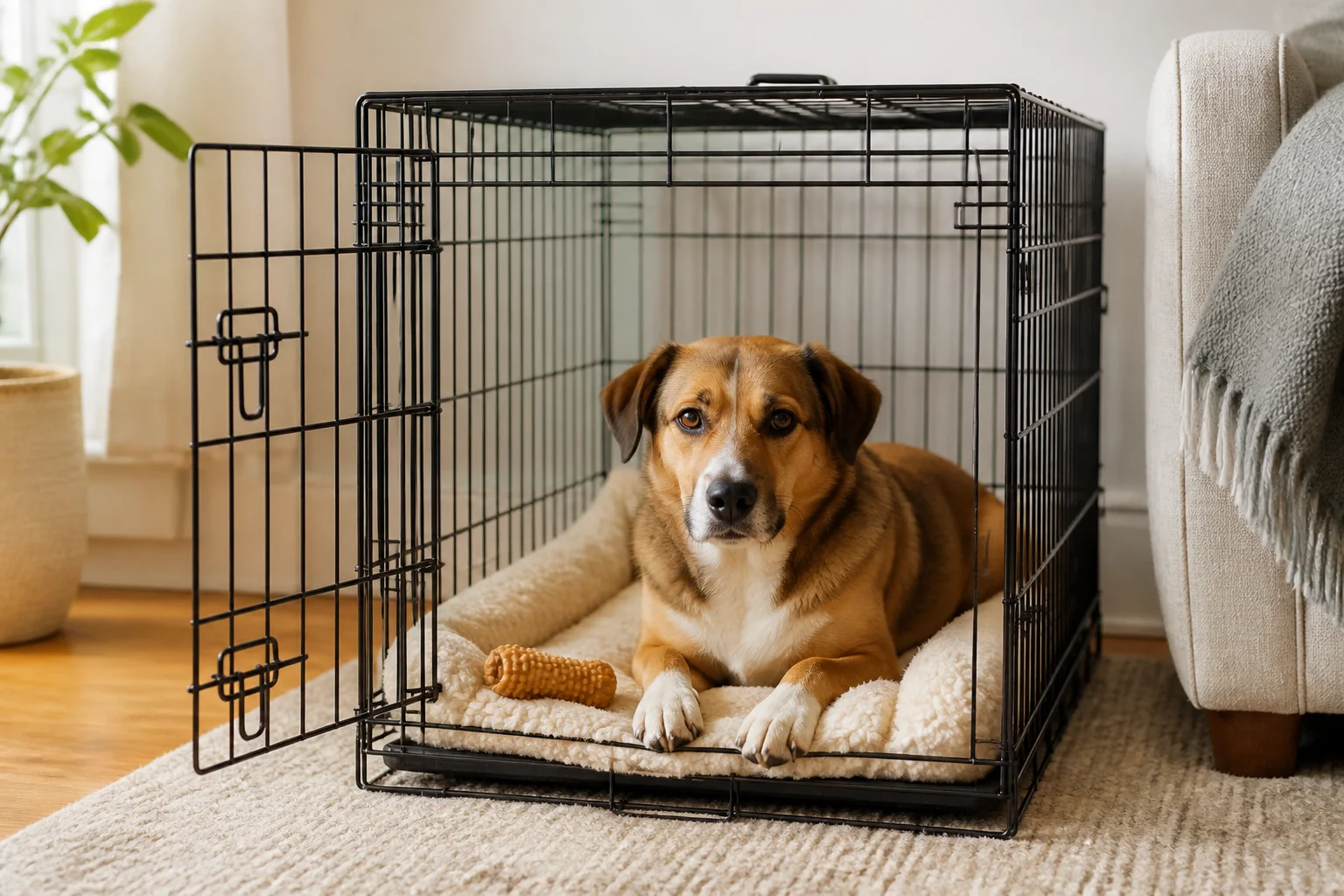
The crate should feel like a choice, not a cage: door open, soft bedding inside, and calm, positive associations built slowly.
A crate is not a punishment; it is a bedroom. Used correctly, it prevents accidents during house training, protects your dog from household hazards when you cannot supervise, and gives her a quiet place to retreat when the house gets busy.
- Feed meals in the crate with the door open at first, so the crate predicts good things.
- Toss treats inside randomly through the day. Let her walk in and out freely.
- Close the door for seconds, then minutes, while you sit nearby, and build duration gradually. Never open the door while she is whining; wait for a pause, however brief.
- Keep sessions short and end on success. If she panics, you have moved too fast — go back a step.
- Never use the crate for punishment, and never leave a dog crated for longer than she can comfortably hold her bladder.
Some dogs do better with an exercise pen than a crate; some do better with a small, dog-proofed room. The principle is the same: a safe, calm space that limits the opportunity for accidents while she learns the routine.
House training a rescue dog
Assume nothing. A dog who was kept in a kennel may have learned to eliminate on concrete; a dog from a hoarding situation may have no concept of "outside." Rebuild the habit from scratch:
- Take her out on a schedule — every 1–2 hours while awake, plus after meals, naps, play, and drinking.
- Go to the same spot every time and wait calmly for 5–10 minutes.
- Reward immediately — a treat within a second or two of finishing, while you are still outside.
- Supervise indoors. Use a leash tethered to you, a gate, or your full attention. If you cannot supervise, use the crate or pen.
- Clean accidents with an enzymatic cleaner so the spot does not become a magnet.
- Never punish. Punishment teaches a dog to hide accidents, which makes them harder to fix.
Expect setbacks. A single accident after two good weeks is normal — especially after a stressful event, a change in schedule, or a new person in the house.
Start the relationship skills
- Name recognition. Say her name, then immediately give a treat. Repeat 10–15 times a day in short sessions. Within days, her name will predict good things — the foundation of every recall.
- Collaborative care and handling. Touch her collar, ears, and paws for a second, then reward. Go slowly. This builds the foundation for nail trims, vet visits, and grooming without fear.
- Alone-time introduction. Practice leaving the room for 10 seconds, returning calmly, and extending gradually. Do not make departures or arrivals emotional. Preventing separation problems in weeks one through three is dramatically easier than solving them in month six.
- Enrichment instead of boredom. Food puzzles, snuffle mats, stuffed frozen toys, and supervised chew time give your dog healthy outlets and reduce destructive behavior.
Weeks 4–8: Building Trust Through Training
Once your dog knows the rhythm of the house and is comfortable in her space, training becomes both possible and enjoyable. The goal in this phase is not obedience for its own sake — it is communication, confidence, and a cooperative relationship.
Use humane, minimally aversive methods
The professional consensus in modern dog training is captured by the LIMA principle — Least Intrusive, Minimally Aversive — adopted as a policy by organizations such as the Certification Council for Professional Dog Trainers. In practice, that means:
- Reward the behavior you want, and manage the environment so the behavior you don't want is less likely to happen.
- Avoid shock collars, prong collars, choke chains, and physical punishment. For a newly adopted dog, aversive methods are especially risky: they can suppress behavior temporarily while increasing fear, and fear is the root of most serious behavior problems.
- When a behavior problem appears, ask what the dog needs and what she is feeling — not simply how to stop it.
The training toolkit
- Charge a marker. Pick a word ("yes") or a clicker, and pair it with food 20–30 times in a quiet room. The marker tells your dog exactly which behavior earned the reward.
- Capture and reward calm. Reward her for lying quietly while you move around. Calm is a behavior, and it can be reinforced.
- Teach one cue at a time. Name before you say it: lure the behavior, add the word, then fade the lure. Five to ten repetitions, several times a day.
- Start with the essentials: name/attention, sit, down, come, leave it, drop it, wait at doors, and settle on a mat.
- Keep sessions to 3–5 minutes. Short, frequent, successful sessions beat long, frustrating ones.
- Train in different rooms and at different times, then generalize to the yard and the sidewalk. Dogs do not automatically transfer a behavior from the kitchen to the street.
Leash manners from the ground up

Loose-leash walking is a skill built slowly, starting in quiet places with high-value rewards and zero distractions.
- Start indoors and in the yard, rewarding your dog for staying near you with a loose leash.
- Reward position, not pressure. Mark and treat when she is beside you; stop walking when the leash tightens, and resume when it slackens.
- Use high-value treats outdoors, and keep sessions short. A dog who pulls toward every smell is usually a dog who has not yet learned that walking near you pays better.
- Consider a front-clip harness as a management tool while you train; avoid equipment that causes pain or fear.
Socialization, safely
Socialization is not "let her meet every dog and person." For an adopted dog, it is the gradual, positive exposure to the sights, sounds, and surfaces of normal life — from a distance she can handle.
- Observe, don't interact. Sit on a bench and reward calm observation of traffic, strollers, and people.
- Keep her under threshold. If she is barking, lunging, freezing, or refusing treats, you are too close. Increase distance and try again.
- Skip dog parks for now. They are high-intensity, uncontrolled environments and a common source of bad experiences for newly adopted dogs.
- Choose calm, vaccinated, well-socialized dogs for one-on-one introductions, on neutral ground, with both dogs on leash and plenty of space.
- Protect her from overwhelming experiences. One bad encounter can undo weeks of careful work.
Weeks 9–12: Expanding Her World
By the third month, most rescue dogs have crossed an important threshold: they trust that the household is stable. Now you can safely widen her world — new routes, new places, new people, new skills — while keeping the pace she can handle.
Broaden the walks and the environment
- Introduce new routes gradually, one variable at a time: a new street, then a quiet park, then a mildly busy area.
- Practice "settle" in public — a mat or a towel and a chew, on a patio or in a park, rewarding calm. This is how you build a dog you can take anywhere.
- Vary surfaces and sounds: grass, gravel, wooden decking, metal grates, stairs, elevators, vacuum cleaners, thunder recordings at low volume. Pair each with treats.
- Keep a "trigger log" of what she notices, what worries her, and how far away she can still take treats. This data tells you exactly what to work on next.
Prevent separation-related problems proactively
Separation-related distress is one of the most common reasons adopted dogs are returned. Prevent it before it starts:
- Practice brief absences daily, starting with seconds, then minutes, then a full trip to the mailbox.
- Ignore departures and arrivals. No long goodbyes, no excited greetings. Keep the transitions neutral and boring.
- Leave a food puzzle or a long-lasting chew so that being alone predicts something enjoyable.
- Record your absences with a phone or camera to see what actually happens — pacing, barking, howling, or sleeping quietly.
- If your dog panics, stop escalating. True separation anxiety requires a structured desensitization plan, and often veterinary support. Escalating absences on a panicking dog makes the problem worse. If you see destruction at exits, nonstop vocalization, drooling, or attempts to escape, seek professional help — and see our companion guide, Dog Separation Anxiety: The Complete Neuroscience-Based Treatment Protocol.
Vet and groomer desensitization
Many adopted dogs arrive with no positive history of veterinary or grooming handling. Build it deliberately:
- Practice handling at home — muzzle, ears, tail, paws, nails, gentle restraint — a few seconds at a time, with food.
- Visit the clinic for "happy visits" — walk in, get treats from the staff, leave. No exam. Repeat a few times.
- Bring high-value food to the appointment and ask the staff to feed during procedures when possible.
- A muzzle is not a failure. A basket muzzle, positively trained, keeps everyone safe and reduces stress in emergencies. Train it as a happy game, not a punishment.
Review the first 90 days
At the end of the twelfth week, ask yourself: Does she come when called in the house? Is she house trained? Does she sleep through the night? Can you leave for an hour without distress? Can you walk past a stranger without a meltdown? Does she recover quickly from surprises? If the answer to most of these is yes, you have completed the hardest part of adoption. If several answers are no, that is normal — and it is a clear list of what to work on next, ideally with a qualified trainer or behavior consultant.
Common Behavior Challenges — and What They Mean
Behavior problems in the first months are usually communication, not defiance. Here is how to read the most common ones.
Resource guarding
Growling over food, toys, or a favorite person is one of the most frequently reported adoption issues, and one of the most misunderstood. Growling is a warning — punishing it removes the warning, not the emotion, and can lead to a bite with no warning at all. Management first: feed separately, remove high-value items, avoid reaching toward the dog's bowl or bed. Then, with a qualified professional if needed, build positive associations with people approaching valued resources. Never test a guarding dog by taking things away.
Leash reactivity
Barking and lunging at other dogs or people usually means the dog is fearful or frustrated, not aggressive by nature. The fix is distance, reward for calm, and gradual reduction of that distance over weeks — not correction. If your dog is reacting within a few feet of other dogs, work with a trainer; our Reactive Dog Protocol masterclass guide lays out a structured, force-free program for this specific problem.
Fear of specific people
It is common for rescue dogs to be wary of men, people in hats or uniforms, children, or anyone who moves quickly. Do not force interaction, and do not let strangers offer food from an outstretched hand. Instead: let the dog choose the distance, have the person sit sideways and toss treats without eye contact, and allow retreat. Confidence grows with choices, not pressure.
Destructive chewing and digging
Destruction is usually one of four things: normal chewing needs, boredom and insufficient enrichment, an inconsistent routine, or stress. Provide appropriate chew outlets, increase physical exercise and mental work, tighten the routine, and confine the dog appropriately when unsupervised — then reassess. See our safety-first guide to choosing chew toys for matching toys to chewing style.
House soiling after adoption
Regression during the first months is common, especially after stress. Return to the basics: schedule, supervision, confinement, reward outside, enzymatic cleanup. If it persists, rule out medical causes with a veterinarian — urinary tract infections, gastrointestinal issues, and other conditions can all cause accidents.
Excessive barking, whining, or pacing
These can indicate pain, anxiety, under-stimulation, or a need that is not being met. Log when it happens, what precedes it, and what relieves it. Patterns reveal the cause; random punishment does not.
When to Bring In a Professional
Professional help is not a sign of failure — it is the fastest route to a good outcome. Seek help if:
- There has been a bite, or a bite seems possible.
- Your dog shows intense fear, panic, or inability to recover after a trigger.
- Separation-related distress includes destruction, escape attempts, or nonstop vocalization.
- Behavior is worsening rather than improving after several weeks of consistent work.
- You feel overwhelmed, frightened, or resentful — those feelings are a signal, not a verdict.
How to choose a qualified professional
- Veterinary behaviorist — a veterinarian with board certification in behavior, the gold standard for serious or medical-related behavior problems, able to prescribe medication when appropriate.
- Certified behavior consultant — certifications such as IAABC's behavior consultant credentials indicate training in behavior science and a commitment to humane practice.
- Certified professional dog trainer — CPDT-KA and similar credentials indicate knowledge of learning theory and a LIMA-based approach.
- Ask two questions: What are your credentials, and what happens if my dog gets it wrong? A good trainer will describe humane, minimally aversive methods and will never recommend pain, fear, or intimidation as a primary tool.
Ten Mistakes That Set Adopters Back
- Too much, too soon. Parties, dog parks, and long outings in the first week overload a stressed dog.
- Giving the whole house immediately. Unsupervised freedom leads to accidents, chewing, and habits that are hard to undo.
- Forcing affection. Hugging, looming, and patting a fearful dog's head teaches her that people are unpredictable.
- Punishing growls, hiding, and accidents. Punishment suppresses signals and damages trust — and it frequently turns a manageable problem into a serious one.
- Ignoring the two-week rule. Most rescue organizations recommend a low-key "shutdown" period of one to two weeks. Skipping it is the most common preventable mistake.
- Switching food abruptly. Digestive upset during an already stressful transition complicates everything. Transition over 7–10 days.
- Skipping the veterinary visit. Parasites, dental disease, and pain are common in newly adopted dogs and can masquerade as behavior problems.
- Expecting the dog to know what she was never taught. A dog who has never lived in a home does not know that stairs are safe, that vacuum cleaners are not predators, or that a couch is not a toilet.
- Comparing her to a previous dog. Every dog arrives with a different history. Give her the dignity of being herself.
- Deciding too soon. The first two weeks are the least representative period of your entire life together. Most "problem dogs" of week one are beloved family members by month three.
Integrating With Other Pets and Children
Other dogs
- Separate first, scent-swap second, meet last. Keep the new dog in her base camp for the first days while the resident dog continues normal routines nearby.
- Swap bedding and rotate rooms so each dog experiences the other's scent without pressure.
- First meeting on neutral ground, both on leash, at a distance, walking parallel — never face to face, never nose to nose, never over a resource.
- Feed separately, forever if needed. Resource conflict is the most common source of trouble in multi-dog homes.
- Watch for silent tension: blocking doorways, staring, stiff body posture, and hovering. Intervene early by adding space and separating resources.
Cats
- Keep the cat's world intact: escape routes, high places, separate litter and food areas.
- Introduce through a barrier or a cracked door for days, then supervised time with the dog on a leash.
- Reward the dog for ignoring the cat. Never let the dog chase "just once."
- Give the cat as long as she needs. Slow is fast.
Children
- Teach children to let the dog approach, to avoid hugging and face-to-face contact, and never to disturb her while eating or sleeping.
- Supervise every interaction for the first months, no exceptions, even with the gentlest dog.
- Create a child-free zone — the crate or pen — that the dog can always retreat to.
- Model calm behavior yourself. Dogs read our nervous systems closely.
Health Basics for the Newly Adopted Dog
- Veterinary exam within the first week or two. Discuss vaccine history, parasite testing, heartworm status, dental health, and any limping, itching, or digestive issues.
- Parasite prevention — flea, tick, heartworm, and intestinal worm prevention appropriate for your region and your dog's lifestyle.
- Spay/neuter and microchip. Confirm both, and update the microchip registration with your contact information immediately.
- Dental care. Start gentle tooth brushing with pet-safe toothpaste, gradually, as part of your handling routine.
- Weight and body condition. Ask your veterinarian to score your dog's body condition, and feed to that target rather than to the bag's generic guideline.
- Nutrition. Choose a complete and balanced diet that meets AAFCO nutrient profiles. If you want to feed a homemade or raw diet, do it with veterinary guidance — see our complete safety protocol for transitioning to a raw diet.
- Insurance or a savings plan. The first year often brings unexpected costs. Budget for them before they arrive.
Your 90-Day Progress Checklist
Use these checkpoints at the end of each phase. They are a guide, not a scorecard — every dog moves at her own pace.
End of week 1
- Eating and drinking consistently
- Using the same potty area outdoors
- Sleeping through most of the night
- Exploring the base camp calmly
- Taking treats from your hand
End of week 3
- Recognizing her name
- Comfortable in the crate or pen for short periods
- Following the daily schedule
- Accidents rare and decreasing
- Approaching you voluntarily for contact
End of week 8
- Sitting and coming on cue in the house
- Walking on a reasonably loose leash in quiet areas
- Handling without panic
- Recovering from surprises within minutes
- Playing with toys and engaging in training sessions
End of week 12
- Calm during a one-hour absence
- Relaxed on a walk past ordinary distractions
- Comfortable with visitors after a calm introduction
- Predictable around other pets in the home
- Veterinary and grooming handling without severe fear
- A recognizable personality — the dog you were hoping to meet
Frequently Asked Questions
My new dog is not eating. Should I worry?
A day of reduced appetite is common during the first 48 hours. Offer a consistent diet, keep the environment quiet, and remove food after 15–20 minutes. Contact your veterinarian if she has not eaten for 24–48 hours, is vomiting, or seems unwell.
She hides from us all day. Are we doing something wrong?
Probably not. Hiding is a normal stress response. Reduce stimulation, sit near her without reaching, and let her set the pace. Most dogs begin seeking contact within days to a few weeks.
Why was she perfect on day one and difficult on day three?
Day one is often a stress-induced "freeze." As hormones settle and she feels safer, she starts expressing real behavior — including testing boundaries. This is a sign of progress, not regression.
Should we take her to the dog park to socialize her?
Not in the first months. Dog parks are chaotic and uncontrolled. Choose calm one-on-one introductions and controlled environments instead.
How long should she be in the crate each day?
Only as long as she can comfortably hold her bladder, and always with appropriate exercise, enrichment, and potty breaks. Puppies and newly adopted dogs should not be crated for a full workday — arrange a midday break.
She growls when we approach her food. What do we do?
Do not punish the growl and do not test her. Feed her in a separate space, avoid approaching while she eats, and work with a qualified behavior professional to build positive associations. Growling is information — suppress it and you lose the warning, not the risk.
How do we know if the adjustment is going well?
Look for trends, not days: fewer accidents, faster recovery from stress, more voluntary contact, better sleep, and increased play. If the trend is improving, you are on track.
When should we consider returning the dog to the rescue?
That should be a last resort, after consulting the rescue organization, a veterinarian, and a qualified behavior professional. Many rescues provide support, training stipends, or foster arrangements precisely to prevent returns. Almost every behavior problem described in this guide is treatable.
Resources That Match This Guide
- The First 30 Days: Complete Training Plan for Your New Dog — a force-free, day-by-day system designed specifically for puppies and rescues.
- New Puppy Training Starter Guide: Your 4-Week Routine — crate training, potty training, basic commands, and leash walking in daily steps.
- The 30-Day Pet Parent Blueprint — the household systems, schedules, and checklists that make the first month manageable.
- Puppy Socialization: The Complete Checklist for the Critical 3–16 Week Window
- New Puppy Checklist: The Complete Guide to Preparing Your Home
- Dog Separation Anxiety: The Complete Neuroscience-Based Treatment Protocol
The Bottom Line
Adopting a rescue dog is not a transaction; it is a relationship built on time. The 3-3-3 framework exists because dogs need to decompress before they can connect, connect before they can trust, and trust before they can learn. Give her three quiet days, three predictable weeks, and three patient months, and you will meet a dog most people will never see — the one who was there all along, waiting for the world to become safe.
Be boring on purpose in the beginning. Be consistent in the middle. Be patient at the end. And when you are unsure, remember the rule that outranks all the others: when in doubt, go slower.
Further Reading and Sources
- ASPCA — Adoption Tips: aspca.org
- ASPCA Pro — Pet Adjustment Periods: The 3 Days / 3 Weeks / 3 Months Guide: aspcapro.org
- Certification Council for Professional Dog Trainers — LIMA Policy: ccpdt.org
- Rover — Understanding Dog Trainer and Behaviorist Credentials: rover.com
- Zoom Room — Adopting a Rescue Dog: The First 3 Days, 3 Weeks, and 3 Months: zoomroom.com
This article is educational and is not a substitute for veterinary or professional behavioral care. If your dog shows aggression, severe fear, or signs of illness, contact a veterinarian or a qualified behavior professional.